It’s 12:30 p.m. on a Friday afternoon in early October and Igloo Ice Rink in Mount Laurel, New Jersey, is quiet. You can imagine that in a few hours the place will be overrun with kids coming in for skate lessons or hockey practice before adult rec leagues face off. But right now, there’s no one behind the front desk. A couple of people skate in the Blue Rink, while across the way in the Red Rink, someone is driving a Zamboni in circles. The gate is pulled down over the snack bar situated between the two rinks, and the surrounding tables are empty. A lone gentleman works on a laptop at the counter stretching along the window overlooking the rink.
After the Zamboni makes one final pass, three young women take the ice. One stretches before skating around the rink’s perimeter. The second shuffles alongside her coach, who’s bundled in a winter coat, presumably going over the plan for her practice session.
Levito has a 2023 national title and a World Championship silver medal.
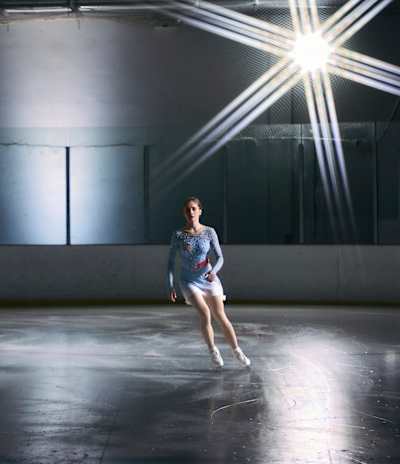
Then there’s the third skater. She’s dressed all in black. Fingerless gloves cover her palms, and her hair is pulled back into a bun. She glides in big looping circles around and across the rink, the blades of her skates scraping the smooth surface of the ice. There’s something about the way she moves that looks different. She’s effortless yet powerful, as if balancing on 4-millimeter-wide metal blades is second nature. The only evidence of her effort comes after she runs through a section of choreography. Hands on her knees, she bends over and catches her breath before running the routine once again.
A typical bystander might think, “That girl’s got talent.” But everyone else at Igloo already knows how talented she is. There are three banners hanging on the far side of the rink that attest to it—2022 Junior World champion, 2023 USA National Champion, and 2024 World Championship silver medalist. And there’s plenty of room there for another banner, too, which could be useful if 18-year-old Isabeau Levito skates well next February in Italy.
Some might say that Levito, one of the top-ranked figure skaters in the U.S., is a lock to represent her nation this winter. That ever since she started rising through the junior national and international ranks and made her senior debut at age 15, all paths seem to point her toward a certain competition to be held in Milan. Her command of technical skating skills, her grace and ability to perform consistently under pressure have garnered comparisons to previous U.S. skating greats like Michelle Kwan and Sasha Cohen, only underscoring the argument that she’s meant to compete in Italy.
Levito describes landing a jump as a "dopamine hit like no other."
And Levito says it feels like fate, because her mother was born and raised in Milan and her family still lives in the area. “When we all found out . . . it felt like destiny,” she says. “It just feels so special, you know?”
When Levito was younger, she was often reminded of her skating potential and what she could achieve, and she says she always knew exactly what she was working toward. “I mean, look at where we are right now, so it worked out,” she says.
But she’s also an 18-year-old who just moved into her first apartment (a few minutes down the road from the rink) and who wants to impress people with her cooking—once she learns more about cooking. She’s a young adult who’s coming into her own and finding a sense of agency and confidence in a life and career that has, at turns, seemed to be guided by an invisible force. And that growth and maturity just might be the key Levito needs to unlock her full potential.
I’ve never lived a life where I didn’t wake up and know I’m a figure skater.
From the outside, the white siding and big red block letters that spell out Igloo Ice Rink make the building look more like a storage facility than a training ground for world-class athletes. But it’s been Levito’s home rink since she started skating at the age of 3. The story goes that her mom, Chiara Garberi-Levito, a passionate figure skating fan, was watching the 2010 Vancouver Games when Levito began imitating the figure skaters on TV. Her mom signed up little Isabeau for group lessons, and that’s where Yulia Kuznetsova spotted Levito. Within a year, Kuznetsova began working with her one-on-one, a relationship that continues today.
“She was born gifted and has such great skating skills,” Kuznetsova says. “Her presentation, her artistry is very special. Her entrance into jumps—you can’t see it.” It’s seamless.
When Levito and I speak, she has just finished her second of three practice sessions on the ice. We’re sitting at a table by the snack bar, and I ask if she remembers those early days at the rink. “That was before I was conscious,” she states simply.
She picks out a green grape from a plastic bag and pauses. “I’ve never had a point in my skating career where I quit, took an extended break or went back to school or anything. I’ve never lived a life that didn’t revolve around the sport. And I’ve never lived a life where I didn’t wake up and know I’m a figure skater,” she says, clearly unfazed by the realization. She pops the grape in her mouth before adding, “Which is crazy to think about.”
Levito's skills and grace have garnered comparisons Michelle Kwan.
Early on, Levito says she was hooked by how it felt to glide on the ice, a singular and unique sensation. As she got older and started competing, she began to appreciate the performance aspect of figure skating, which she likens to fitting puzzle pieces together. But the thing she really loves? Landing a jump or hitting her music cues perfectly. She describes it as “a dopamine hit like no other.”
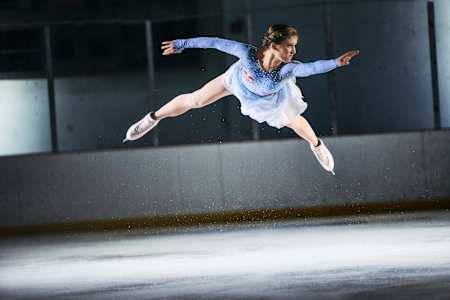
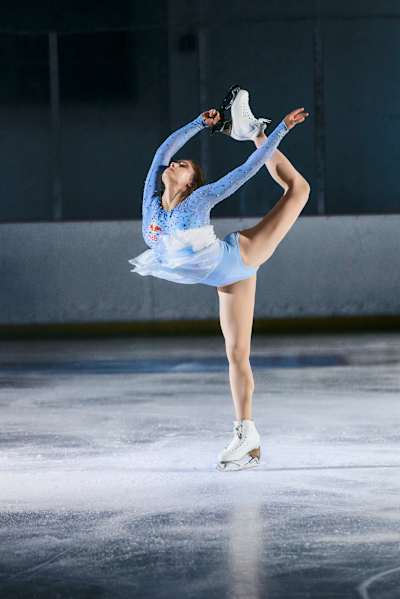
There is a lyricism to the way Levito skates, and when she hits those musical beats in her performance, you feel it in your body, too. During practice, she executes a jump where she takes off, pulls her body tight in a powerful twist and lands on the outside edge of her skate. As her arms sweep up, the smile on her face broadens ever so slightly. Like a dancer, her body simply becomes an expression of the music.
Even though Levito displayed prodigious talent and skill from the time she started skating, it wasn’t until she landed her first double axel that she was convinced in her own mind that she might have a future. Double axels are challenging jumps, requiring technical precision and strength. Skaters take off on the outside edge of one foot and complete two and a half rotations in the air before landing backward on the opposite foot. “It’s a make-or-break jump,” Levito says. “Either you quit trying or you land it, and you end up going farther in competition or all the way.”
Initially, Levito didn’t think she’d ever land a double axel and worried she’d have to quit skating. When she was 10, she nailed it and recalls thinking, “Oh, so I am going to make it.” But it also came with the realization that she felt like she had to make it in the sport. “I have to make use of all this time and energy [that I’ve put into the sport]. I have to make it worth it,” she says.
“She was born gifted and has such great skating skills,” says her coach.
If Levito wanted to be a world-class skater, she would have to train more. When she was around 9 years old, she transitioned to full-time online school, freeing up more hours for skating. But she missed being in school. She missed socializing with her friends.
“Around 13 or 14, I remember thinking, ‘I hate this so much,’ ” she says, hastening to clarify, “not the skating, but I felt so lonely, so isolated.” There weren’t really any other kids to hang out with at the rink, and she didn’t have many friends. At the same time, her training intensified dramatically. She was competing internationally as a junior, traveling around the world, and it amplified the sense of loneliness.
It’s a trade-off and sacrifice that athletes—especially young athletes in technical sports like figure skating—have to make if they want to compete at the highest level. Even then, Levito knew that she could always stop. That if she just said the word—if she told her mother that she wanted to go back to school—her mother would let her quit, no questions asked. “But I always knew that if I stopped what I was doing, I would be wasting something that could be so much for me,” she says. She would be wasting her talent, her promise.
But you also have to wonder, when you’re a prodigious talent, when you show potential at such a young age, how much of the dream to compete at the highest level is due to what others have told you—or expect of you—and how much of it is your own dream? And how can you tell the difference? This is a riddle that Levito is just now starting to untangle.
There was one thing that threatened to keep Levito from her destiny to compete on the world’s biggest stage—injury. In October 2024, Levito fell while landing a jump during the free skate at Skate America, an event that’s part of the International Skating Union (ISU) Grand Prix series, and dropped from first to third place overall as a result. She was annoyed by her mistake because she thought she could win—and defend her title.
But her foot hurt during the event. Levito said she thought it was an irritated muscle, but it turned out to be a stress reaction in a bone in her right foot. While it wasn’t a fracture, it did make doing even the most basic things—like walking—painful. Skating and jumping, where she often takes off and lands, on her injured foot? Out of the question.
Levito's workout regimen extends off the ice and includes flexibility work.
The timing couldn’t have been worse. Levito had entered the 2024-25 season with high hopes after earning a silver medal at the 2024 World Figure Skating Championships in Montreal—the highest result for an American female figure skater since Ashley Wagner in 2016 and what Levito refers to as “the highlight of my life”—and the injury occured during the crucial period in the run-up to Milan.
Levito was anxious to get back on the ice, to salvage her season. After all, not only did she want to represent the United States in February 2026, but her whole life revolved around training and the competitive season. When she wasn’t competing, she was touring with figure skating shows like Stars on Ice. Sitting still wasn’t exactly something she was used to. She was restless and bored at home with nothing to do except homework for her senior year of high school.
Every three weeks or so, Levito would test her foot. It would feel OK while she practiced skating skills but then as soon as she’d try a single lutz—one of the six main jumps in figure skating, where skaters use the toe pick at the front of their skate to assist in launching them into the air—it immediately hurt. She tried cross-training to maintain her fitness, but even riding the stationary bike kept her foot from healing properly.
It was a frustrating cycle of fits and starts. She had to withdraw from her second Grand Prix assignment in November and eventually from the 2025 U.S. Figure Skating Championships in January, too. In the end, she was off the ice for three months.
“When I was saying earlier that I had never lived a day in a life where I wasn’t a figure skater, I thought about when I was injured but then I thought no, because even during those three months, I just kept thinking, when am I going to skate again?” she admits. “Every 30 minutes or so I would wiggle my toes to see if it still hurt. It was the only thing I thought about.”
It was the first forced break from routine in 15 years, and Levito says she didn’t feel like herself. If she could at least still train, even if she couldn’t compete, that would be one thing. But all she could do was watch while everyone around her continued to compete, step up on the podium, win medals. She would instead drive to Barnes & Noble and pretend to be a regular college student studying for class. It was hard to stand by and feel like the world was moving on without you.
Levito brings a bit of old Hollywood glamour to the ice.
By the time Levito was allowed to compete again, she felt undertrained, but she was so ready to be back on the ice. “You know when you have a cold and your throat hurts? You think, ‘I’m going to be so grateful when my throat stops hurting.’ It was like that,” she says. “I learned to be grateful for every moment I can dig my foot into the ice and not be in pain and not second-guess when I put my foot on the ice.”
Previously, just thinking about Milan made Levito so nervous she’d be “on the verge of hyperventilating,” she told me. But since her injury, that’s changed. “All this hunger for the opportunity to fight and to skate and to compete, plus the adrenaline of the Olympic year, has turned into excitement instead of nerves.”
The camaraderie among her fellow competitors helps too, making the sport—which once made her feel so lonely—feel like they’re all in it together. “I understand that we compete against each other for the ultimate prize, but it’s not that deep,” she says. “I may be competing against Alysa Liu the skater, but I’m not competing against Alysa Liu the person.”
Levito had always been hungry to be the best, but the injury made her even hungrier. Maybe it was the time away from the rink and the realization that this thing that she’s been doing her whole life, a thing that she loves and has defined her identity since before she was conscious, could be taken away from her. But you get the sense that the hunger has become more personal for Levito. That it’s her own. That she wants it for herself and not only to fulfill the potential that others have seen in her.
Levito wants to make people feel an emotion when she skates. 'That’s the best compliment. I think that’s what I value the most.'
“Have you seen her red dress?” Kuznetsova asks me.
Levito’s longtime coach skated over to the bleachers where I’m watching her longtime pupil practice. When I tell her that I haven’t seen the dress, she lets out a dramatic sigh and tells me it’s gorgeous. This season, Levito is skating to a medley of songs performed by Sophia Loren for her short program. Her ruby-red dress and gloves and her sparkling crystal necklace are befitting of the Italian movie star.
Later, I ask Levito about the dress and the short program. “Yulia told you? She’s such a yapper,” she says with a roll of her eyes.
There’s an ease to Levito’s relationship with her coach, no doubt born out of years of working together. And one of the perks is that Kuznetsova knows the kind of music that will best showcases Levito’s skill and talent. “I think she had music picked out for [Milan] probably four years ago,” Levito says.
The same goes for the choreography. “She has an idea in her mind and then she makes me try different movements,” Levito explains. “Maybe something will inspire her with the way my arms naturally go up or something.”
Levito brings a bit of old Hollywood glamour to the ice, especially when she skates to songs like “Moon River” from last year’s short program, or soundtrack excerpts from Cinema Paradiso and the Sophia Loren medley for this year’s free skate and short program. Such music allows her to step into the roles of different characters and tell a story through her performance. And when she does that, something magical happens.
Because at the end of the day, whether or not Levito makes the trip to Milan or comes home with hardware, she says that she wants to make people feel something—an emotion—when she skates. “It’s the best compliment,” she tells me. “I appreciate having the ability to do that. I think that’s what I value the most.”