
Wakeboarding
How I Train: pro wakeboarder Cory Teunissen on his fitness regime
Australia’s own four-time wakeboarding world champion reveals how he takes care of himself during a gruelling season.


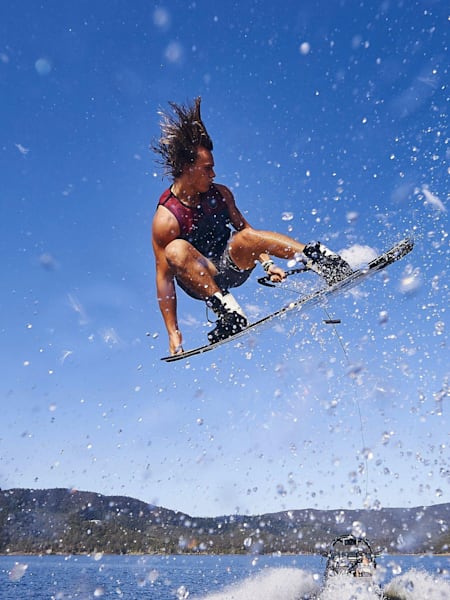
Watch Cory Teunissen on a run and you’ll appreciate the thousands upon thousands of hours that have gone into making him a four-time world wakeboarding champion. The 24-year-old Aussie holds himself in position while being towed by a boat, waiting for a wave that’s cresting just the right way. When he finds it, Teunissen springs into the air, flipping and twisting with chaotic precision.
It takes a lot of work to stay on top of the mountain, as Cory reveals in conversation. His training regime starts with a gruelling pre-season that leaves him “struggling to walk out of the gym” and then transitions to an in-season program focused on injury prevention and maintaining his high athletic standards. Alongside coach and close friend Nam Baldwin, Cory’s training is an optimal balance of pushing oneself and working intelligently to protect the body from the “pretty weird positions” wakeboarders find themselves in out on the water.
Cory also delves into the mental side of training — the way that training has helped shape his mind, as well as his body. It’s a routine that has helped crystallise personal and professional goals, as well as helping him realise the full extent of his considerable talents.

Cory Teunissen poses with his wakeboard and boat in the water
© Photographer Credit: Brett Hemmings / Red Bull Content Pool
01
What would a typical day of training look like for you when you’re in-season?
Whenever I’m in season, it’s all about maintaining whatever I’ve done in the off-season. I’ll train a minimum of twice a day — maybe twice on the water, or maybe once in the water and then a session in the gym, depending on the day. During the season, I’ll probably go to the gym twice or three times a week. When I’m in the gym, I’m not doing any strength work — it’s all body movement and keeping my body open. We get into some pretty weird positions on a wakeboard, so I’ve got to try to keep my body open and functioning properly.
My program on the water is essentially only 20 to 30 minutes, but for the whole time it’s full on and high-intensity. I’m going hard for that. It’s a pretty short training session, but you’re maxed out.
I try to put my body through more difficult states at home so that when I’m at an event, I’m more comfortable.
02
Wakeboarding requires a lot of strength, but you’ve also got to stay nimble to twist and contort the way you do on a board.
Is there a specific way you tailor training to balance the two?
Yeah, definitely. A lot of that work comes during the pre-season. I’ve worked with Nam Baldwin for the past seven years now and we’ve got an unbelievable relationship. Nam’s been a huge part of my success. He knows me very well and knows exactly what I need. In the pre-season we focus on a lot of strength work, doing a lot to get our muscle fibres working the way they should be.
Whenever we wakeboard, we essentially beat ourselves up on the water and go to the gym to feel better. We go to the gym just to get our bodies back to where they should be, or where they need to be.
During a pre-season, it’s very different; I’m struggling to walk out of the gym. But if you look at a wakeboarder’s body, knee injuries are the most prominent injuries that you’ll see. You will see a minimum of two or three ACL injuries each season. So, we do a lot of strength work in the legs and core.
Lifting weights is almost pointless for what we do. Wakeboarders need to be super strong, but also light and nimble.

The upper body work will come with the foundations that we do in the gym and on the water, but it’s more strength, balance and hand-eye coordination in the gym rather than trying to lift as much weight as possible. Lifting weights is almost pointless for what we do. Wakeboarders need to be super strong, but also light and nimble. It’s tough to properly hit the balance, but I’m lucky to have someone like Nam in my corner to help out. It feels almost like cheating getting to have him.
03
It’s quite special that you’ve got a coach with whom you go way back. How did you meet?
Mate, he’s been a huge part of who I’ve become as a person and an athlete. I owe a lot to Nam and his partner Devo. I consider them some of my closest friends and a huge, huge influence over me.
We met through Red Bull, actually. Before Nam, Red Bull set me up with Wes Berg (former Australian ironman). Wes was great and we’re still friends today, but I think Red Bull started me off with Wes because they knew I wasn’t ready yet for the difficulty that Nam holds as his standard.
After a season with Wes, Red Bull connected me with Nam and we just clicked straight away. We hit it off and had a great connection from the start. We got to work, and it’s completely changed who I am as a person and as an athlete.
I first started working with Nam when I was 17. As I’ve matured and gotten older, I’ve learnt a lot more about myself, my morals, and what I want out of the sport. Essentially, I’ve learnt what my goals are. Nam’s been in my corner to help create that path, and make the path a lot clearer to me. He’s been a great influence in keeping me on my toes and keeping me knowing who I am and what I want out of myself.

Cory Teunissen catching air in front of a white wall
© Photographer Credit: Mark Nolan / Red Bull Content Pool
04
Would you say the personal journey you’ve gone on through your training has been just as important as the process of getting, say, fitter or faster?
You definitely learn a lot more about yourself as a person and what’s actually possible. If I’d looked forward and seen some of what Nam and I have done over the years, I’d have thought, “Dude, there’s no way I could do that”. But the slow progress that you create for yourself happens over time and you learn what your possibilities are.
05
You’ve worked back from a shoulder reconstruction and won world titles. How much do you have to factor in injury management to how you train?
Everything we do in the gym is injury prevention. Nam and I put ourselves in situations that are going to put your body through more stress and in tougher situations than you’ll face out there in competition. If you can put your body through it in training, you’re going to be pretty sweet.
There are situations, the one-percent cases, where you get injured but that’s just high performance sports. It’s a risk you take every time you do your craft. While the majority of training helps you progress as an athlete and get better at your craft, you're also getting stronger, fitter and more flexible. You’re building, building, building, which definitely helps with injury prevention.
If you ask any athlete, we’re so in touch with our own bodies that we’ll know when something’s not feeling right. The best athletes know when something’s off, they know what to change and how to get themselves back to feeling the way that they need to feel to perform at such a high level.
Nam and I use the phrase ‘flow state’ to describe when everything becomes, in a way, easy in the gym or out on the water. It comes when I know I’m feeling good, I’m healthy, I’m eating the right things, I’m slim and I’m it. That’s when the real progression starts to shine. You get into that state and you start steamrolling like, “Oh, alright, let’s keep pushing, I’m feeling good”. You can slowly progress from there by not doing too much.
We always try to improve by one percent at a time, rather than ten percent.
We always try to improve by one percent at a time, rather than ten percent. If you’re trying to go for unbelievable achievements in training, is this going to put too much of a strain on your body? I think the real results come when you feel it out, when you’re feeling good and know when it’s right to keep going and keep pushing.
06
How does a can of Red Bull influence your training?
If I’m home, I’ll train two or three times a day. If I’m feeling tired by the afternoon, I’ll definitely crack a can before going out on the water or hitting the gym.
But Red Bull really influences me on multiple different levels. It’s an honour being a Red Bull athlete. You could ask anyone on the Red Bull crew: there’s a standard that we have to live up to because we’re part of an exclusive team. Red Bull believes in us so much that they want to support our lives and support our dreams, and provide us with so much. So, really, performing to the standard is almost like our way of supporting Red Bull and giving back to them for supplying us with so much.
I’m unbelievably grateful and very thankful for the opportunity that Red Bull gave me to work with Nam so long ago. What really sets Red Bull apart are the connections that they have within the business. We deal with the best, right? I probably would have never been introduced to Nam if not for Red Bull. Getting to work with him has taught me so much about the craft, about sportsmanship, and the level of expectations I need to set for myself. I feel like we’re one big family!