
Padel
How to choose the right padel racket to improve your game
Find out how to choose the right padel racket to give you performance and comfort on court, whatever your level of play.
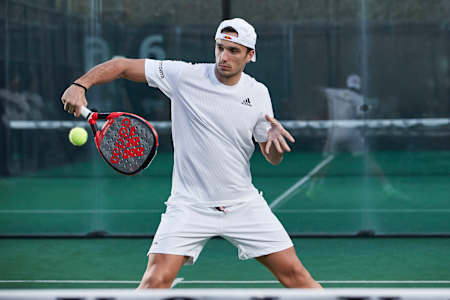
The Premier Padel competition has been touring the world since the end of February, showcasing the best in the sport in some exceptional matches. As you may have noticed, the players play in pairs, not just with their partners, but also with their rackets. So if this sport has caught your eye or you're simply looking to improve your game, we thought it was important to find out about the potential of a good racket. Because choosing one is no easy task, we've decided to put together a guide to help you find your best ally on the court.
First of all, it's important to know that a good racket will prevent you from injuring yourself, but above all it will allow you to enjoy your game to the full.
To choose the right racket, you need to take into account a number of factors, including its shape, its weight (a few grams can make a big difference), its balance, the materials used and your level and style of play.
Don't panic, it may sound impressive, but we'll explain it all in this guide:
Find out more about padel:


01
The different types of padel racquets
The shape
There are only three different shapes of paddle racket:

Les différentes formes de raquettes
© https://www.padel-beach.com/blog/les-differentes-formes-de-raquettes-au-padel-n10422.html
- ROUND: The round shape has a balance close to the handle, which offers more manoeuvrability. Paddle rackets with a round shape have their sweet spot right in the middle, which makes them more forgiving than others. It's easier to forgive centring errors thanks to its balance, which provides greater precision and control. This type of racquet also allows you to direct your shots to get out of complex situations, so it's more suited to the offensive player. The downside is that it doesn't provide enough power for good smashes.
- DIAMOND: The diamond shape is balanced at the top of the racket. This upward weight distribution provides greater power gain, which unfortunately reduces the sweet spot. As a result, we'd recommend this racquet if you've got good technique and a centre shot, making it ideal for attackers. It's also more difficult to handle because of its pronounced forward weight, which gives a feeling of heaviness.
- WATER DROP: The perfect mix between a round and a diamond racket: the water drop shape. It offers a good compromise between power and control with a neutral balance point in the centre of the racket. With this, you'll feel more in control of your shots in any situation your opponent tries to throw at you. It's a racquet that allows for a large number of spin options and adapts easily to your game. That's why it's the most popular type of padel racket.

Premier Padel
© Premier Padel
02
Criteria for choosing a padel racket
Balance
Directly linked to the shape of the racket, balance gives you control over your shots and trajectory. And once again, it's as simple as that: there are three types, each linked to a different racket shape. Here they are:
- BAS (low balance): The main weight is placed in the handle, close to the body, which makes the racket easier to handle. You'll find this aspect in round racquets.
- MIDDLE (neutral balance): The weight is distributed in the middle of the racket, giving it a good balance between power and manoeuvrability. This corresponds to teardrop-shaped racquets.
- UP (high balance): The weight is placed in the head of the racket, which gives it a lot of power. However, this makes it less manoeuvrable and requires a good basic technique to master. The diamond shape adds complexity but can give you a lot more power.
Weight
It may not sound like it, but weight has a considerable influence on your game. There are three different weights for paddle rackets. Before presenting them to you, it's important to know that the heavier the racket, the more power you'll have to hit the ball, but your shots will be less controlled and the racket will be harder to handle. Conversely, a lighter racquet will give you more speed and manoeuvrability, but you may lack a little power.
- LIGHT: <340 grams
- MEDIUM: 340-360 grams
- HEAVY: >360 grams

Foam types
For padel enthusiasts, it's not easy to find your way around, especially when it comes to sponge. First of all, foam is the component found inside the core (the outer part of a racket, or more simply: the part that comes into contact with the ball). So you can't afford to neglect your choice, especially as we're going to explain the difference between the two types of foam. Because, yes, there are two.
The first is flexible foam. As its name suggests, this is a fairly elastic and light foam. It maximises the bounce of the ball on impact (which means more power for slow shots, but less for hard ones) and reduces vibrations when hitting the ball, so you'll be much more comfortable with your racket in hand!
Examples of brands and ranges: EVA Soft or FOAM.
Then there's the choice of rigid foam, which increases power on big hits and makes it easier to control the trajectory of the ball. On the other hand, you lack a little comfort because of its rigidity.
Examples of brands and ranges: EVA, EVA Mid or even EVA Hard.


Materials used
The type of surface of a padel racket corresponds to the material that covers the foam. If you've followed this far, you'll know that it's also called the core. This is the part of the racket that will be in direct contact with the ball, so it needs to be durable over the long term. There are two different types at two very different prices...
FIBREGLASS: Fibreglass is soft and heavy. Many paddle rackets are equipped with this material because it is the most affordable. A fibreglass-covered padel racket has a lower resistance, which makes it possible to obtain a wider sweet spot, offering a more intense sensation on ball impact and greater forgiveness.
CARBON FIBRE: Carbon fibre is much stronger, providing greater impact resistance. Being lighter, it reduces the overall weight of the racket, making it easier to handle. Carbon densities vary: 3K, 6K, 12K and 18K are the main ones. This density is specified by certain brands, which will give you an idea of the frame's strength. As the number increases, the paddle becomes stiffer.
03
Find the right paddle for you
Beginners
If you're a beginner, we'd advise you to go for a manoeuvrable racket with a wide sweet spot, to give you greater landing tolerance. That's why we recommend a round-shaped racket with a soft sponge.
- WEIGHT: Light (<340 g)
- SHAPE: Round
- BALANCE: low (in handle)
Example of a racket for beginners: Adult padel racket - Kuikma PR 500 yellow

Raquette padel pour débutants
© Kuikma
Intermediate
For intermediate or more regular players, you'll need a more versatile racket to support your technical base. So you can have fun trying to be more precise or more powerful depending on the situation. A racket in the shape of a teardrop with the sponge of your choice (don't hesitate to try out both) will be your best ally.
Read more news :

- WEIGHT: Medium (340 to 360 g)
- SHAPE: Water droplet
- BALANCE: Medium (neutral)
Example of a racket for an intermediate level: SIUX TRILOGY GO 4 2024

Raquette de padel pour joueur intermédiaire
© Siux
Expert
The most hardcore of you, even the experts, need a diamond-shaped racket. With a hard sponge, you'll have more power, and combined with your technique, your opponent will have nothing to worry about!
- WEIGHT: Heavy (>360 g)
- SHAPE: Diamond
- BALANCE: High (high)
Example of a racket for an expert level: ADIDAS ADIPOWER MULTIWEIGHT 3.3 2024 RACKET

Raquette de padel pour un joueur expert
© Adidas
Now that you have a racket worthy of a professional, go and watch the pros play for inspiration! Replays of the matches are available here.