

Bike
MTB
Get to know the new Santa Cruz 29er V10
We get the inside take on the MTB that’s got the paddock talking at the Lourdes DH World Cup.
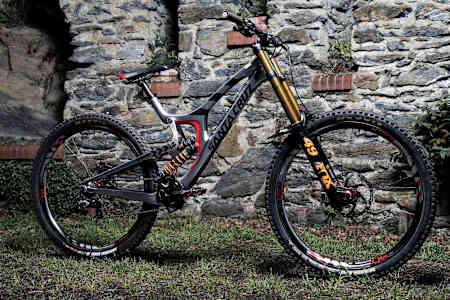
Luca Shaw's Santa Cruz 29er V10
© Bartek Woliński/Red Bull Content Pool
As the Downhill World Cup circus reconvenes for the season opener in Lourdes, France, this weekend, riders gather to discuss their off-seasons, teams welcome new riders and, more to the point, we get to feast our eyes on new and improved bike tech.
This year there’s a lot to talk about. Namely Santa Cruz’s new 29er V10: the Californian brand’s flagship downhill bike just got wagon wheels. All three SC Syndicate riders – Greg Minnaar, Luca Shaw and Loris Vergier – will be on board this beast for the Lourdes race and beyond.
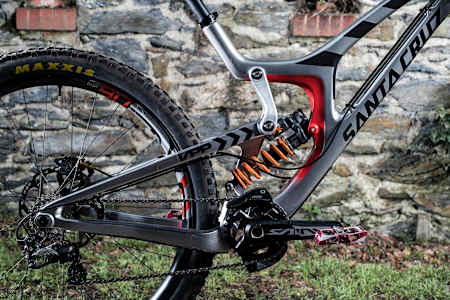
A stock V10 frame with many adaptations elsewhere
© Bartek Woliński/Red Bull Content Pool
Reasoning
Why increase wheel size from the recently standardised 27.5”? The answer is simple: against the clock the Syndicate found the bigger 29” wheels to be faster. It’s within the rules (they even double-checked), and furthermore the team’s three riders are just as – if not more – comfortable on these bikes.
After a long few months of testing and customising the bike to accommodate bigger wheels, the team arrives in France confident that there will likely be no going back to 27.5”.
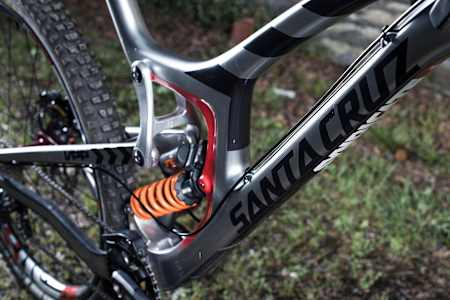
Santa Cruz tried out multiple chassis set-ups
© Bartek Woliński/Red Bull Content Pool
We took a look around Luca Shaw's 29er V10 bike and sat down to speak to long-term Syndicate mechanic Doug Hatfield to find out what went into the making of this beast.
From A to E
Doug Hatfield: Firstly, we’re using a stock frame, the same as we used with 27.5” wheels, but we had to change a few things to accommodate bigger wheels. We had to change the suspension linkages – upper and lower – and we tried a few different progressions along the way.
So now we have an A Link, B Link and all the way to an E Link, which is the most progressive and what Greg Minnaar is using. This differing linkage determines how progressive a shock is going to be – meaning the level to which it gets firmer through its cycle.
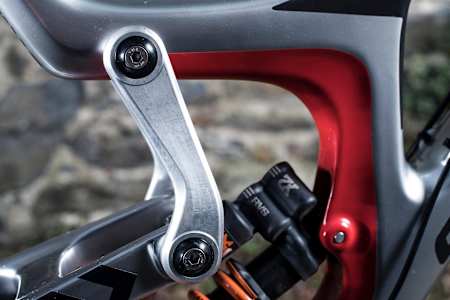
Suspension linkage
© Bartek Woliński/Red Bull Content Pool
DH: We had to make a whole new swingarm to accommodate the rear wheel and to form it around the linkage that we were customising. The travel takes a different path now, so we had to modify the saddles – we had to make a cut out so the seats wouldn’t buzz the rear tyre. Fi’zi:k made us completely new saddles just for that reason. There are a lot of custom parts even though we’re running a stock front end.
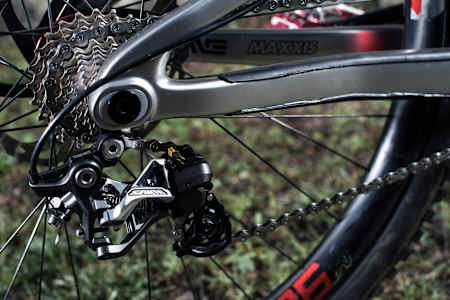
Custom made Swingarm set in carbon
© Bartek Woliński/Red Bull Content Pool
The squeeze
DH: We were mainly changing the lower linkage, but once you go too far you have to change the upper too. It’s been a big learning curve but now we’re settling into what we have here, which is a B upper and D lower linkage on Loris and Luca’s bikes.
Greg preferred something a little different and since he has an XXL bike we could actually give him a little extra suspension travel, so he’s running what we call an E Linkage top and bottom: there’s simply more room to accommodate the bigger wheels. When you go to a smaller bike – Luca Shaw is running an XL bike and Loris Vergier an L – there’s less room to work with so that makes it a bit harder to accommodate the wheels.
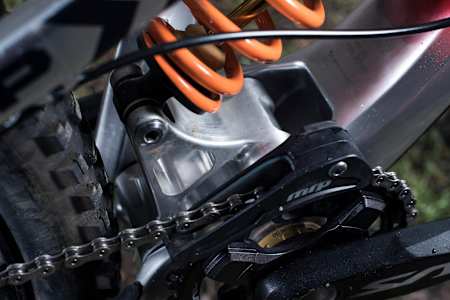
Lower link detail
© Bartek Woliński/Red Bull Content Pool
DH: But then on the other end of it, when you put the big fork on it – the new Fox 49 fork – Greg’s bike is all of a sudden harder to fit because the headtube’s longer and it’s harder to get the bars down to where you want them to be. So we’ve been learning a lot about how to build the bike.
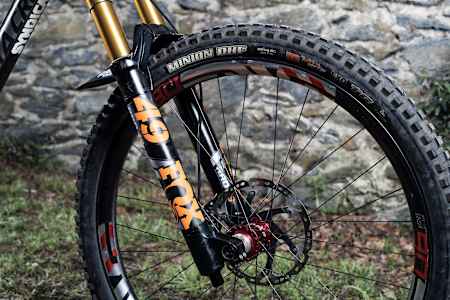
The Fox 49 fork that's got everyone talking
© Bartek Woliński/Red Bull Content Pool
Geometry
DH: We’ve used a custom Chris King Buzzworks headset that’s more compact and we’ve decreased the angle on it by one degree, but the geometry is nearly the same as our old V10s. The bottom bracket is only a couple of millimetres higher than on the old bike and the wheelbase is a little bit longer ,but that’s mainly due to the fork on which they increased the offset by around 5mm compared to the 27.5” version.
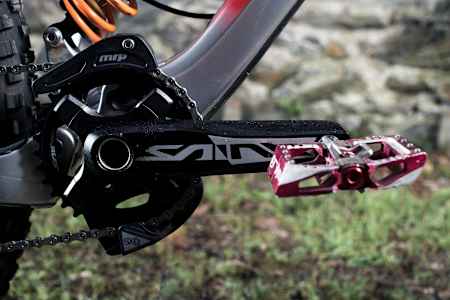
Shimano Saint groupset throughout
© Bartek Woliński/Red Bull Content Pool
DH: The bike doesn’t feel much different when you’re riding it. People think that it’ll feel slower in and out of turns etc., but you sit on the bike and you adapt to it pretty quickly. The main thing is that it just seems to carry speed and it rolls over obstacles better. And there’s no weight difference – size for size they’re basically the same. In fact the swingarm’s actually lighter than our old one.
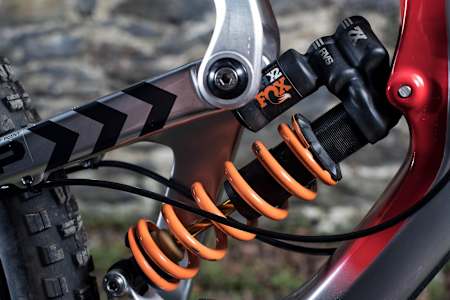
Fox DH X2 coil shock on the rear
© Bartek Woliński/Red Bull Content Pool
Pulling it together
DH: This process started at our December camp when all of our riders got together. We introduced our new riders Luca and Loris to our team there and Greg just kept pushing and pushing, saying we needed a 29er. We’d been thinking about it for years but the thing is, we could have built a bike but you need a fork, you need a set of tyres etc., and a lot of things have to come together. The right components weren’t there at that point.
We went from a start point when we were testing with non-downhill specific 29er tyres and rims, to where we are now and everything has come together with a finished frame and components.
So we started piecing things together at that camp and we took it from there. First, we came out with a prototype rear end made from aluminium. That was the whole start of the process. Maxxis didn’t have a tyre yet so we were working with them and they were making the moulds, and working with Envy who had to make moulds for their rims.
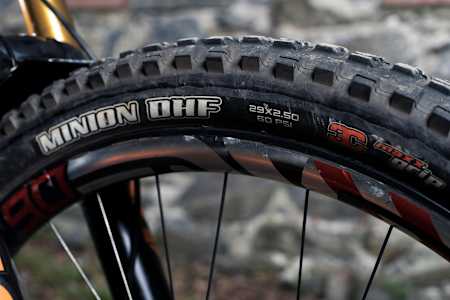
The Maxxis Minion DHF tyres have been upscaled
© Bartek Woliński/Red Bull Content Pool
Launching into Lourdes
DH: We were planning on running the bike in Fort William in June – we didn’t really think about doing it for this race and then all of a sudden everything started clicking so we went for it. We don’t have the old bikes on hand – we’re committed to these bikes now.
At some point in the season if there’s an issue we can always go back, but we’re trying to progress these bikes so really it’s up to the rider. If the rider wants to ride 29 or 27.5 bike he has the option. But right now it’s such a new thing and we’re excited about it so we want to say we’re going to stay on the 29er… but nobody really knows. It’s the first race.
Watch how the Santa Cruz Syndicate boys gets on with the new V10 29er at the Lourdes DH World Cup, LIVE, on Red Bull TV or here on RedBull.com/Bike from 1 PM CEST on Sunday, April 30.


