
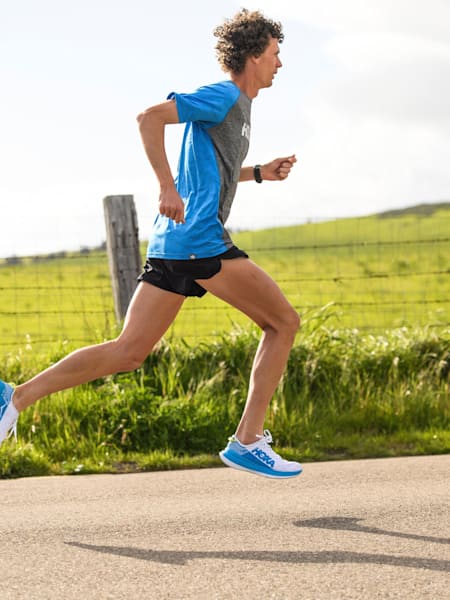
Ultrarunning
This is what it takes to run 50 miles faster than anyone on earth
US ultrarunner Jim Walmsley recently achieved a world best time for running 50 miles. Here he reveals what went into conquering the leg-sapping landmark.
Four hours, 50 minutes and 8 seconds – about the same time it takes most of us to escape IKEA – is all it took for US ultrarunner Jim Walmsley to set a new 50-mile record earlier this month.
Competing at May 4’s HOKA ONE ONE Project Carbon X 100K Challenge in California, where he averaged 5:48 per mile on his way to nailing the fabled half century distance, Walmsley beat the previous record by 43 seconds.
The invitational consisted of a 32k straight run between Folsom and Sacramento followed by nine laps of a 7.5k loop. Having originally aimed to break the 100k world record as well as the 50-mile record, it was as much a lesson in adaptation as it was human endurance for Walmsley.
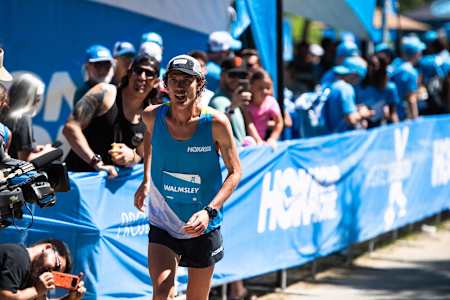
"The 50-mile was as important as the 100k for me"
© HOKA
Once he broke the 50-mile record, the trail star dropped his tempo, knowing deep down that he'd pushed his body too far to sustain a bid to beat the 100k record as well (for the 50-mile record to stand he had to finish the 100k regardless). Then there was the weather: even for a Californian spring, the heat was far more intense than anyone expected, reaching upwards of 22C and having a big impact on the runners' performances.
In hindsight, going all out for the 50-mile record may just have been the wisest decision of all. Here's what went into making that impressive milestone...

Pavement pounding was a big part of training
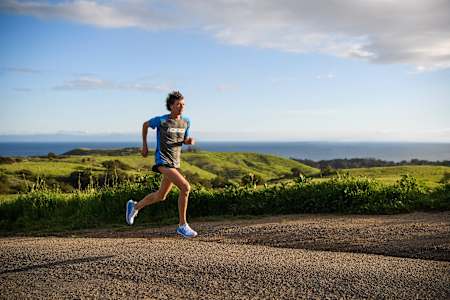
Walmsley is one of the hottest names in trail running
© HOKA
Normally more at home on the trail than concrete, Walmsley upped his road mileage ahead of the record attempt: "It was about getting on my local road and finding that pavement, letting the legs absorb the asphalt. That’s the most challenging thing with a road record. It’s not the pace, distance or time per se, it’s the culminative effect of pounding and whether your body holds up the pace over the time and distance. You don’t go and pound 62 miles on the asphalt very often."
Once a week Walmsley also headed out to a running track, "banging out 1-mile intervals at 5.40 pace" because, as he says himself, "it’s really important to find that rhythm and find that pace." Averaging around 130 miles in distance and 20,000ft of vert per week, he even threw in a few canyon runs in his native Flagstaff to keep him nimble.
He had experience he could draw on
Throughout early 2019, Walmsley competed in a variety of races he felt would help in some way ahead of his record attempt, including January's Houston Half Marathon: "I started the year at Houston, which was a bit of a change of pace, and threw that in there with this race in mind."
Not only did it add an extra few miles in the tank for road running, Houston proved to be a beneficial experience in the mental sense, too. Needing needed to finish within 1:04:00 to qualify for next year's U.S. Olympic Marathon Trails, incredibly, he finished the race in Houston at 104:00 exactly – right on the nose.
He got into the mindset of the previous record holder
To beat the 50-mile record meant beating legendary ultrarunner Bruce Fordyce, who set the previous record during 1983's London to Brighton ultramarathon. Walmsley reveals he did his homework: "I’ve been reading a few books by Bruce Fordyce, searching [online], learning who’s had the past records and who has current records for a deeper knowledge of where things are at. The 50 miles has some prestige with the age of the records, and is the oldest ATF record in the books."
Watch-checking was an obsession
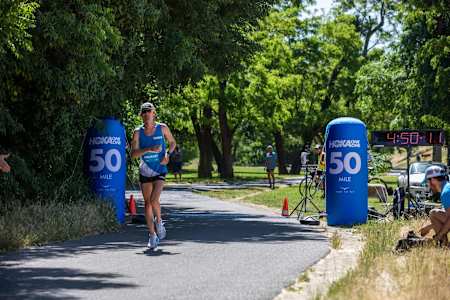
Baking hot temperatures took their toll on the runners
© HOKA
So blistering were the temperatures on race day, even the pacers dropped out sooner than expected ("all week I felt you had to get a base tan beforehand because the sun beats down on you – I think everyone slowed down a lot," says Walmsley). This meant time-checking became even more important to keep his rhythm now he was solo. Lucky for him he's a bit of an obsessive in that department:
“You’ve got to get your mindset ready to find that place and dig in. In a trail race you get to be a little more free-spirited, and get to run more by intuition. 100k road is controlled, that’s why it can be a world record – for good and for bad, it’s a lot more restrictive. It sucks to look at your watch and keep worrying about split times, but I’m decent at it, and obsessive about it, and I’m always watching my watch no matter what."
Molehills gradually turned into mountains
Despite regularly eating mountains for breakfast, Walmsley was surprised by the elevation on the seemingly flat Sacramento road course, its dips and bumps gradually chipping away at his calves. "The hills were short both in length and height – they’re hardly even hills, but they’re punchy when you’re pushing and running out of sugar and going through ebbs and flows; some of them hurt a lot. At one point I was thinking 'You guys are stacking stuff on top of this hill – it’s tougher than the last time I came around.' They were punchier than I preferred."
Impatience cost him the opportunity to beat both records
Taking a leaf out of Fordyce's book (he owns enough of them), Walmsley claimed going into the race that he would channel the legend's mantra of 'caution'. Following the race, however, he admits he was overly cautious in the first 20 miles and subsequently spent the next 20 miles "paying it back", which cost him the chance of going for the 100k record as well.
"Maybe I should have [been cautious] in the second 20 miles. I probably got a little too impatient. I should have waited and it would have evened out the splits altogether. But at the start of the race, even if there was only 100-150ft drop for the first 18 miles, it felt really flowy and good.
"I have a slightly impatient personality where I'm a little too quick and ambitious and I’m starting to pay for that. You’ve got to learn and build and improve yourself, so I need to keep working on that. As Bruce Fordyce once wrote, track/marathons reward aggression, whereas in ultrarunning cowards tend to persevere."
He had to shift the mental goalposts
Aware a 100k record was now very unlikely to happen due to sizzling temperatures and not-so-perfect pacing, Walmsley had to push these thoughts to the back of his mind as he set his sights on the 50-mile mark: "I like running with some instinct. Ignorance is bliss – the more competitive you get and the more ignorant you can be, the better. You’ve got to ignore anything that might be negative and build on positives, and figure out how to lie to yourself and believe it and bring as much confidence as you can.
"It’s best to split these runs into sections in the mind," he adds. "The last third’s the most important as you’re going to lose or gain the most amount of time there. You’ve got to dominate the last third."

Sometimes you don't need to chase two rabbits
If Walmsley hadn't made the 50-mile record, would he have pushed on for the 100k record anyway? “Yeah, I would have started adjusting sooner and not thrown in those 5.35s [minutes per mile]." He also cites a recent quote from Eliud Kipchoge who, when asked about his next race after winning the London Marathon, replied: "I only chase one and that was London."
"That rang in my head a little bit," says Walmsley. "You don’t know if you can hit a 50-mile world best unless you go and try, and it wasn’t in the cards for me to get a 100k on the day, but I’ll have the opportunity to have another go in the future."
Jim Walmsley was speaking after May 4’s HOKA ONE ONE Project Carbon X 100K Challenge. You can buy the Carbon X shoe at selected stores and Hokaoneone.eu from June 1.