
MTB
How pioneering mountain bike brand Marin stays true to the sport's roots
The California-based company has been making bikes since 1986. But its deep connection to the founders of downhill racing make it more than just a manufacturer...
Marin Bikes is a bicycle manufacturer that sells globally and rides locally; it’s a company that has seen great success across the world since its founding but hasn’t grown too big for its boots. Now in its fourth decade, Marin retains a small but dedicated staff who love nothing more than making and riding bicycles.
As its name suggests, the brand was born out of Marin County, California, a sun-kissed area north of San Francisco where picturesque rolling hills of golden-yellow grasslands are flanked by green mountains that are kept fresh and lively thanks to daily fogs rolling in from the nearby Pacific coast. It is a dreamy place, full of Californian promise and the hippies who expound it, and something of a pilgrimage for mountain bikers.
The sport was invented here in the nineteen seventies by long-haired free thinkers who loved nothing more than to push a bicycle to the top of the iconic Mount Tamalpais and rattle back down it, a hobby in the hills that would later become an Olympic sport practised around the world. By the early eighties, a number of folk began to produce and sell bikes, and what began in various garages around Marin County soon spawned a worldwide craze — mountain biking was born.
Marin Bikes was a product of the movement, and, since its founding in ’86, it has sold millions of bikes, has won racing titles at the highest level and has enjoyed its moments at the top of the sport. But it has also had its lows, resulting in a change of ownership around 2011. Since 2013, Marin has seen a steady rise back to the forefront of mountain biking under a new leader and a reinvigorated staff. We recently visited the company in its headquarters on the edge of Marin County to see for ourselves how things are shaping up, and the way in which Marin is staying true to the roots of mountain biking.
Pulling up to Matt and Lisa VanEnkevort’s house late-evening in July, a cool breeze floats through the eucalyptus trees as the Pacific mist seeps into the Novato valley. On the drive here we crossed the Golden Gate bridge and toured the coast and hills, spotting on the map Stinson Beach, Muir Woods, Nicasio and Fairfax, namesakes for bikes in the range of a brand that is wholly entwined in this area.
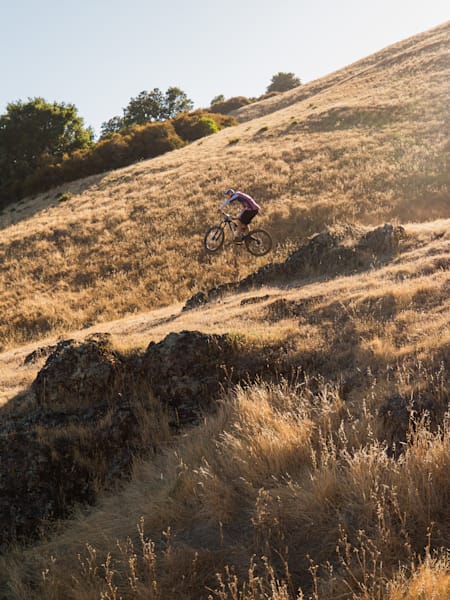
Matt Jones riding the trails outside Fairfax, California
© Laurence Crossman-Emms
We are staying with the VanEnkevorts because ‘Marin treats its guests like family’, and, we are told, a hotel would have been boring anyway. Our hosts, who we are meeting for the first time, greet us with a warm welcome and we pile into a slap-up barbecue feast of Alaskan proportions (Matt is from the 49th state and embodies its outdoorsy wildness — ‘I have literally every power tool in the world’ pretty well sums up this big character) while we watch the surrounding hills fade into a purple sunset.
Matt is hesitant about turning the conversation towards work, but he is excited about the brand that employs him and can’t resist giving us a quick history of Marin Bikes, all the while pointing to remote landmarks lazily sinking towards darkness. Mount Tam, the place it all started, is over there; the company’s original headquarters, which was really a recording studio rented from the band the Grateful Dead, just down the road; great trails spread across the region, some more legal than others. And with that, Matt says a cheery goodnight and heads to bed. He’s got an early start tomorrow after all — at 5:30am he’ll be out riding his mountain bike and he’ll be at the office for 8. He is, after all, the company CEO.

The Marin team. Left to right: Matt VanEnkevort, Matt Cipes, Chris Holmes
© Laurence Crossman-Emms
As a kid growing up and racing mountain bikes in the very distant UK, which was so very different to the place we now stood, I knew about Marin Bikes from a young age. They were everywhere. I had friends who rode them, saw lots of people on them at races, and through the brand’s marketing was aware of the dusty golden place from which they came. Marin had spread its wings worldwide and it seemed like an enormous enterprise, a behemoth with, presumably, rigid management and very serious businesspeople behind it. I had carried that impression through my life.
Marin has had its tough times and no one in the company is trying to cover that up. The departure of its founder, Bob Buckley, and its restart in 2013, brought Matt V into the fold and with it a fresh perspective. New investors would of course want progress, but Matt’s vision was based on honesty and the core of cycling. From there, the brand could rebuild itself based on its original premise of making great bikes for the masses — reliable, not too pricey, fun to ride. The company is now comprised of smiling grafters who believe in its future and will work hard to make sure it keeps heading the right direction. Matt leads by example — it’s not often you see a company CEO staying late to wash the bikes at a demo day, but that’s the way his Marin rolls.
But now the barrier was down. Matt, and Lisa, who doesn’t officially work for Marin but does really (they can’t help but treat it as a family business), were down-to-earth, friendly and, above all, deeply passionate about bikes and having a good time riding them. Knowing the top chief was clearly so true to the company’s mantra — ‘Made for Fun’ — I felt assured the rest of our visit would only reaffirm that this was a cool, core brand on the rise again.

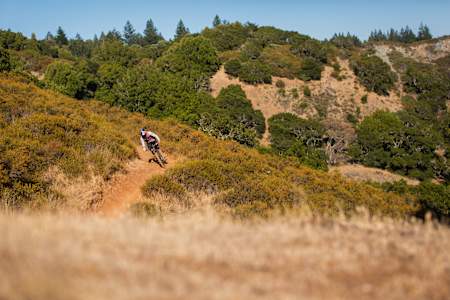
Matt Jones riding where mountain biking was born
© Laurence Crossman-Emms
Today we are heading to Fairfax, the town where the infamous Repack downhill race used to burn coaster-hub brakes, and what is now the site of the Marin Museum of Bicycling and Mountain Bike Hall of Fame. Its small downtown is typically Californian — the postcard California of swaying leafy trees and peace and love and sunny serenity — and easy-going locals are beginning their days at airy coffee shops. Signs of the town’s cycling heritage are abundant, with bikes new and old shored up along the streets and tributes to Repack scattered around town.
Mountain biking started in the surrounding hills and, although the sport still comes up against prohibitive access laws in its own backyard, it continues to thrive as an understated hotspot for trail riding. We are guided by Marin’s Chris Holmes out into the riddle of tracks at Camp Tamarancho, twisting and turning our way up into the forest on purpose-built singletrack that is much-frequented by Marin staff, whether testing bikes or just feeling the Cali flow. Chris, who heads-up the brand’s global marketing, is another down-to-earth, mellow guy who is most excited talking about the FRS, the brand’s ground-breaking full-suspension bike that won the first ever downhill World Cup series under Jürgen Beneke in 1993.
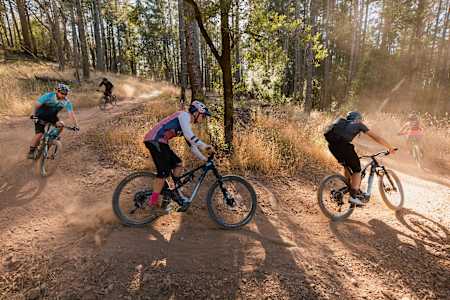
The Marin staff on a team ride in Marin County, California
© Laurence Crossman-Emms
Reaching a high point at the furthest point on our loop, Chris stops the small group to point out some more Marin landmarks and to explain a little about the brand’s recent history. Red Bull’s Matt Jones is in tow and listens intently to the story of his bike sponsor. It’s also Matt’s first visit to Marin’s home. In a similar fashion to the way we’ve weaved our way through the woods, Marin has gradually climbed back towards the top of the sport in the years since its rebirth in 2013. However, Chris explains, its roots have never been forgotten. Pointing his finger, Chris traces a zigzag line down the mountain across the valley — the ever-present Mount Tam — and recounts some second-hand tales from the early days of the sport, stories learned from the company’s in-house storyteller extraordinaire, Steve ‘Gravy’ Gravenites, who is a mechanic for the company and a true local who grew up hitching rides to the top of Mount Tam so he could bomb it back down on his old klunker bike. Gravy, and others like him, anchor Marin to the legacy of mountain biking, Chris says, modestly omitting his own deep history in the world of two wheels.

Matt Jones leading the pack on his first visit to Marin’s home
© Laurence Crossman-Emms
In Petaluma, which is just outside the County itself, we are introduced to the company’s headquarters, which is a roomy, light-filled and unassuming building in a quiet corner of the town. We are greeted by a small gang of happy office dogs, staffers’ pets are welcome here, and take a look through the entrance hall’s permanent exhibition of iconic bikes. The walls here literally tell the story of Marin: there’s the Madrone Trail, the first bike Marin produced; the Team Titanium, the bike that recalibrated Ti bike pricing and was piloted by National Champion Joe Murray; the Ti FRS (which means ‘Front Rear Suspension’); some of Marin’s first city bikes; and a modern-era Wolf Ridge, a bike that made a big statement upon its launch thanks to its distinctive suspension system.
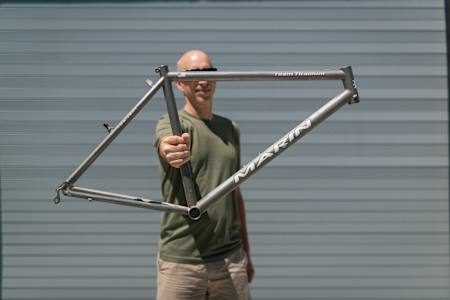
An original Marin Team Titanium frame
© Laurence Crossman-Emms
Employees work diligently but the atmosphere is light. Chris is in the corner of one large office room, busy but not rushed — surely the sign of well-organised affairs — and Matt V is in another; as boss he has his own office, although the door is always open. There are surprisingly few people — what seems like a massive company from the outside is, in fact, run by a couple of dozen motivated, positive cyclists who keep their heads down and just get on with their mission of making fun bikes.
Out the back is the workshop area, where we find Matt Cipes and Aaron Abrams, two of the driving forces behind Marin’s recent bike designs. Cipes, aka Cippy, a Californian through-and-through, is working on the next generation of e-bikes that, he hopes, will help get more people on the trails (and be a lot of fun too, if his smile is anything to go by — they are ‘sweet-ass bicycles’, he notes). Abrams, who grew up in his dad’s bike shop and has worked in every corner of cycling but found his home at Marin, takes us for a cruise around the block on the hardy town bikes he is developing. These have big tyres, luggage racks and a comfortable riding position — they are bikes for the masses.
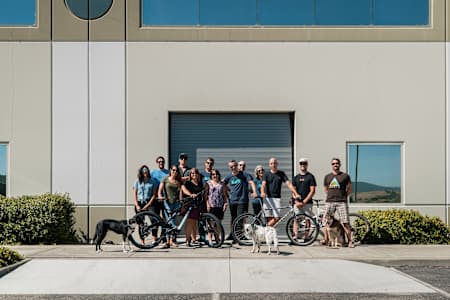
Team Marin outside their HQ in Petaluma, California
© Laurence Crossman-Emms
That more or less sums up Marin Bikes. Bikes for everyone. As Matt V later puts it in his bellowing Alaskan drawl, ‘You know, I wanna make bikes that I wanna ride … I’ll go out and ride our $400 hardtail mountain bike and you’d be amazed at how good it is’ — Matt’s enthusiasm works its way through the entire staff. The company has a common goal, which he summarises while showing us his throwing axes in the garage: ‘…everybody who works [at Marin] bought into the concept of making a better bike and making something they could go out and have fun on. I think that’s what keeps the team going and making better and better bikes’.
And on that note, it’s time to go. A staff ride is about to take off into the hills and everybody’s invited.