
Ultrarunning
How Ireland’s Conor O’Keeffe ran 32 marathons in 32 counties in 32 days
Agonising injuries. Ice baths. Sweltering temperatures. Community spirit. Here, the endurance athlete analyses the ups and downs of his unforgettable challenge.
Most people get through their entire lives without being lucky enough to run marathon distance.
Not Conor O’Keeffe. The ultrarunner from Cork has just ran 32 of them - in 32 days, in 32 counties, and (often) at temperatures well above 32C - finishing this unique feat in his hometown on 28 August.
Two years later than planned (owing to a worldwide pandemic), this challenge of a lifetime required a 42.2km run in a different county of Ireland every single day.
O’Keeffe, 30, who has raised over €67,500 and counting for mental health charity Pieta House, began the attempt while wearing a 32-pound vest to symbolise negative thoughts. He would shed a pound a day from the vest as he progressd.
Having suffered from severe bouts of depression and suicidal thoughts in the past, previously telling Red Bull that finding ultra-endurance sports allowed him "to work through my own demons and the reasons why I felt so bad", the podcaster has made it his mission to raise awareness of mental health and anxiety and could find no better way to do that than with Project 32.
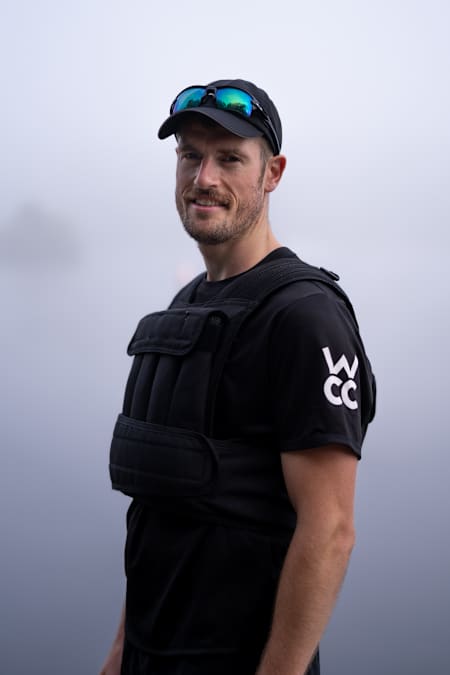
Conor O'Keeffe is a an ultrarunner, podcaster and mental health advocate
© 528 Creative
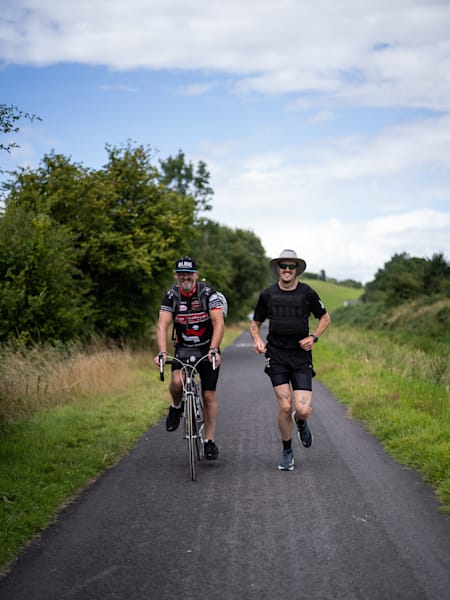
Our hero was joined for the entirety of the challenge by his dad, Greg, who cycled alongside his son during every marathon and would also provide vital assistance to help solve the fiendish logistics behind the scenes.
The start date was originally set for September 2019, but numerous lockdowns forced O’Keeffe to temporarily shelve the project - which he now realises was probably for the best.
“Looking back, it was a blessing in disguise. I don’t think I had any idea what it was going to take to do it first time around. I don’t think my body was in the right shape to do it. I didn’t do the hours in the gym, I didn’t train for purpose, I wasn’t built to carry weight, I was built to run – you need to be stronger than I was at that time.”
So, what exactly did it take to make it through 32 gruelling marathons with all that weight and the oppressive heat of one of the fiercest summers on record? Assessing his highs and lows, O’Keeffe reveals all…
01
I trained by wearing my weighted vest to the shops
“I originally bought a 44-pound vest and only later manipulated tubes to get it down to 32 pounds. I actually prepared for my challenge by doing weighted runs in the heavier vest and would even walk around the supermarket wearing it. People probably saw me coming towards them in the aisles wearing this bulky vest and thought ‘this guy is obviously in some sort of a feud’!“
02
I set my start date when I realised I was going to become a dad
“I found out my partner was pregnant this year so I knew I couldn’t postpone Project 32 any longer. After the scan I decided to start in late July and go into late August so at least I’d have it done before the birth. In fact I ended up telling my family and friends the start date of Project 32 before the baby was announced. Nobody involved in the challenge knew why I was in such a rush, and my dad was telling me it’d be better to start in September due to the cooler weather. When I told everyone the real reason for the early start they were over the moon.”
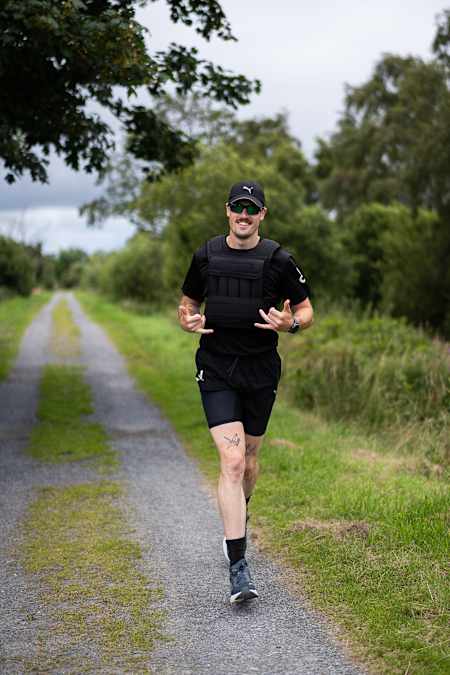
Conor gets down to business for Project 32
© 528 Creative
03
It didn’t take long for injury to strike
"At the beginning I had problems with my feet. They have the smallest muscles, the smallest bones, and yet they take a brunt of my force because every ounce of weight is on top of them. As a result of the non-stop running I was starting to get stress fractures on my feet and plantar fasciitis [a inflammation of the thick band of tissue that runs from the heel to the toes] which was very painful. After the first day I had my feet and left ankle strapped up to the point where the two feet could barely move, there was no flexion between my toes."
04
I opted against cold hard data in favour of listening to my body
"Over 32 days there was no music in my ears. Instead I simply listened to my body because when you’re running all day every day you become incredibly intuitive at being able to sense when things are wrong and when they’re right. After about the eighth day, I took all the strapping off my feet because I knew my body wanted it to let them move again.
"My longtime coach came out for eight days to help me on Project 32 and was a star. 'You know what you need to do, it’s up to you’, he told me, knowing full well I was going to run on how I felt. I wasn’t using data points or measuring my heart rate. He loves a good old dose of science, and I do too when it comes to nutrition and training, but this was listening to my limbs."
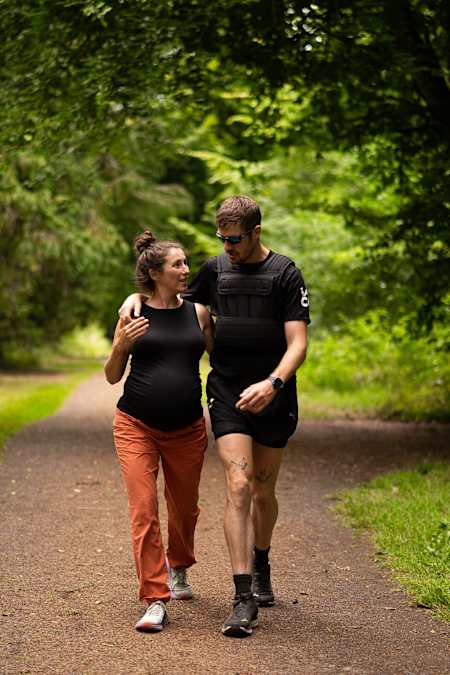
Conor and his partner Mel during some rare downtime
© 528 Creative
05
My niggles would change as the challenge went on
"A lot of initial injuries started to settle down after the first 10 days. But then others would flare up. I still had lots of muscular fatigue, aches and pains; my shoulders started to tighten up towards the end and I’d get severe headaches as the tension on my neck was so high. And as the vest started to get lighter, it would move a lot more to the point where I was getting chaffing across my lower back and collarbone as a result. Luckily, this was all stuff we could try and manage.
"My two achilles were f*cking killing me in the middle of the project, they just felt completely different, I was rubbing them they didn’t even feel like they belonged to me, they felt loose. Instead of a rounded shape, they were almost a square shape. One part of my calf was working super hard and the other part wasn’t working at all, and that was causing a loosening of my achilles, so they weren't as taut or as strong as they should be."
06
I’d done some warm weather training, but the Irish summer was brutal
"I knew that I wasn’t going to control everything. When you know loads of things are going to have to go right, you know some things are going to go wrong. A few weeks before the project kicked off I had a two-week holiday in Tenerife where I could do 25km runs in dry island-type heat. I drank Red Bull during training and hydrated with water but the heat sucks the energy out of you. I believed it was fantastic preparation for maybe three or four hot days of running - I just didn’t expect 20 hot days. It was ridiculous - for 32 days we experienced no rain, even in traditionally wet and windy places like Mayo and Donegal. It was baking. I hadn’t ran in thick heat like that since I was a Thai boxer in Thailand as a youngster."
07
I had to get creative with salt
"One thing I noticed early on was when I stopped I had a thick layer of crust on my vest where the sweat had soaked through, been hit by the sun and left a white powder. This told me I needed more salt in my body to keep my electrolytes up, so we went into a McDonald’s and took about 100 salt packets. Every bottle of water I was drinking then had both a hydration tablet in it as well as a packet of regular table salt, which helped with heat exhaustion and boost my electrolytes."
08
I was eating the equivalent of five loaves of bread per day
"One of the main reasons beside sleep that I recovered so well that I took on 600grams of carbs every day, in the form of Maltose, which was like pure starch basically. Throughout project 32, my intake was the equivalent of 40-50 slices of bread, or between 1800 and 2000 slices of bread. It's insane I got that much food into me, but I’d built up a tolerance of that in training. I needed carbs, calories, and protein for muscle recovery."
09
The logistics of mapping was almost as difficult as the running
"The original way we’d planned to do Project 32 was to travel on roads and footpaths, ideally heading towards the next county. But I didn’t care about spending a bit longer in the car if I had a nice safe place to run. I tried to find a route in each county that was relatively flat as half of Ireland is mountains, so you can’t escape it. But I knew if we had rivers with walkways, canals with footpaths then they’d have to be fairly flat. I typed in canals Ireland into Google and got about 7 routes straight away.
"Problem was - I didn’t realise how tired I’d get and how early into the project. As soon as I finished a run my body was like ‘boom, let’s power down’, meaning it was often hard to plan the next step and plot a course for the next spot. Thinking logistically was a challenge in itself."
10
It made me appreciate how brilliant Irish people are
"I could not have done Project 32 without the love and support of all the people we came across, and it’s testament to the whole island of Ireland from north to south that every single person who had heard what we were doing was like ‘Come inside, eat in our pub’, giving pints on beer to the lads; it was very heart-warming. By my final marathon I had no doubts humanity was fantastic and will always help you out.
"We stayed in hotels, Airbnbs and guest houses but one of the most wonderful parts of the challenge was getting to stay with friends throughout the country - some I’d never met before and only knew from social media. Everyone was so welcoming, it was fantastic."
11
Finding ice for ice baths was tricky
"I’d finish up a marathon with the usual lallygagging around the place which involved trying to get the bike back into the car. We’d then spend time driving around looking for places to buy eight or ten bags of ice if we could but the whole f*cking country was using ice because it was so hot! This saw us often driving to different shops for two bags of ice here, and four bags of ice there. It was so hot every day that I began to really enjoy the time getting into baths. I'd stay in one for 15 minutes to cool everything down. They really helped me get to sleep as they are helping your body to slow down."
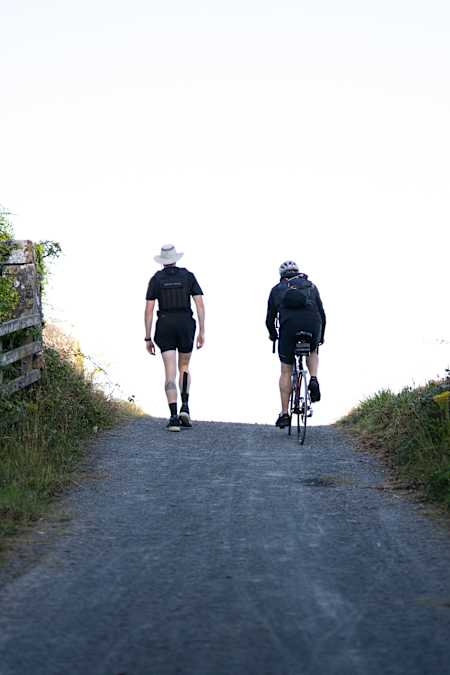
Conor O'Keeffe, on foot, and his father Greg, on bike
© 528 Creative
12
Having my dad cycle alongside me was extra special
"Getting to run alongside my dad, who was on a bike, was amazing. I’m expecting my own son now of course, which is fantastic because a boy learns from his dad, how to love and how to be loved. He teaches you how to do that by loving you. I’m sure I'll only realise how much of a magnificent thing it was for my dad to be able to do that when I have my own son. We had similar conversations to these along the way. He warned me that fatherhood all goes in the blink of an eye. Oddly, it was like I’d returned to him as a kid again - for each marathon I would drink six pre-prepared 500ml bottles of water my dad would be up late after I had gone to sleep, mixing bottles in the kitchen like he would have done when I was a baby with formula. It was like the passing of a torch, or bottle..."
13
The journey was a long time coming for my dad
"My dad turns 60 next year and before Project 32 he never been to Northern Ireland. He grew up during The Troubles and later became a solider himself, patrolling the border in the eighties where he'd hear of shooting in the North, so he never visited as a young man, nor has he visited since. But he came up for the challenge and had what he told m was 'one of the most fantastic times' up there. It's a beautiful part of the world. The kindness that people showed us, the stories we got from people was unreal. After we finished project 32, my dad immediately went on a trip with my mother to show her the north."
14
My last few marathons were nervy in more ways than one
"I had bad sciatica in the back of my knee last year and did a lot of rehab to sort out those nerves. It caught up with me eventually as towards the end of the project I’d be in a stride running and my hamstring would contract and pull my foot up towards my backside, like someone hit it with a dart. The nerves were trapped in my lower back, and that started four days from the finish. I thought this could be a really bad end to this, but luckily my coach gave me some physio with isometric and stimulation exercises, and we managed to get it under control. I felt better than I had in weeks. In fact my last two marathons were the fastest I’d done. I did the second one in 04:18:00."
15
Finishing Project 32 felt like closing a chapter of my life
"When I reached the end and saw my friends and family there, even strangers, I felt love and acceptance. I’d started project 32 with I love and accept myself now. I used to suffer from post event blues, where I didn’t have purpose or meaning following a challenge. But this time I was mentally preparing for the end at the start, I was ready. Like any good adventure, it's got to come to a close so another one can start…like fatherhood."


