
Art
An Oddbird is breaking through Delhi’s performance arts scene
Oddbird Theatre is a breath of fresh air for those saturated with the rigid performing arts landscape in New Delhi. Akhil Wable and Shambhavi Singh discuss their journey in establishing the theatre.
It is often said that the goings on in New Delhi and the rest of India, are dictated by a handful of influential judges, bureaucrats, politicians and industrialists residing in Lutyens Delhi.
From their palatial homes and Raj-era offices, spread over an area of over 28.7 square kilometres and flanked by peepul, jamun, baheda and neem trees, these men and women have decreed that homosexuality is illegal, digital economy is the future, and an Aadhar number is the only one that matters.

Indeed, among the litany of reasons used to criticise Delhi is this centralisation of political power. It isn’t just power that’s trapped in the central vistas of the city. Every major performing arts space born in New Delhi is located near the corridors of political power.
For an evening of classical dance, jazz performances and Hindustani music, Delhiites step out to the India Habitat Centre or the India International Centre on Lodhi Road. Five kilometres away, the National School of Drama, Kamani Auditorium, Little Theatre Group and the Shri Ram Centre for Performing Arts constitute the city’s original theatre district, in Mandi House near Connaught Place.
But while political power remains trapped in central Delhi, a quiet attempt is on to liberate the performing arts from the stuffy orthodoxy of these powerful corridors. Oddbird Theatre and Foundation, a year-old venue, is one step in that direction.
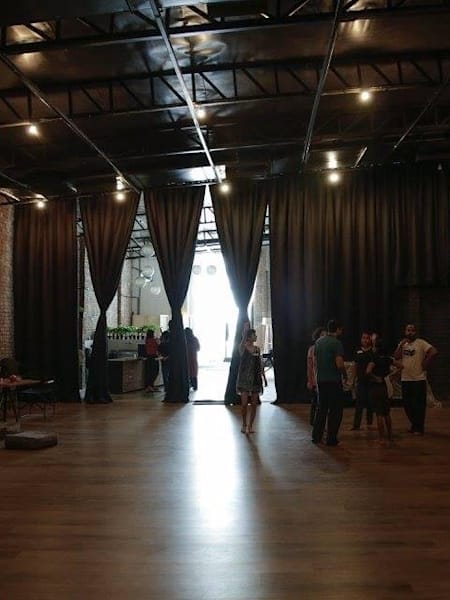
Oddbird is located in Chattarpur, on the edge of the city, close to the watchful eye of the Qutub Minar. It is helmed by Akhil Wable, a former engineer at Facebook and Shambhavi Singh, a former marketer. It opened its floor-to-ceiling glass doors in June 2016, with an experimental music gig that had electronica artists performing for 60 people. Since then, they’ve hosted wide-ranging events, such as a solo performance based on a short story by the Russian dramatist Nikolai Gogol, an ensemble musical featuring an Estonian folk singer and Hindustani classical musicians, and a play based on the letters of poet Faiz Ahmad Faiz — who wrote them to his wife when he was in jail.
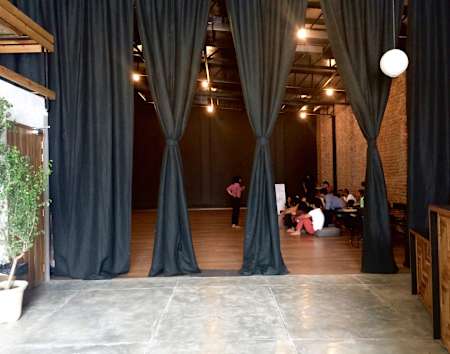
Oddbird Theatre is an open space performing arts centre
© Virkein Dhar
In the constellation of performing arts spaces, Oddbird occupies an unusual position – one that’s challenging a status quo from a distance. “Oddbird is a godsend because, in Delhi, all auditoria are proscenium stages and in much more formal venues like Habitat or the Mandi House venues, the performance space and the audience space are very clearly separated,” said Bikram Ghose, founder of The Tadpole Repertory, who has performed there.
“They [the performances] are formal and, because of the atmosphere inside, they feel stodgy. So Oddbird was a breath of fresh air because it was an open space. It became popular for that particular,” he added. Initially, it was an effort to get people to come here but, Ghose said, it was something worth doing.
Along with Black Box Okhla, a new theatre venue in the city, Oddbird has an “independent mind to do something very specific in the city,” he explained. Tickets are priced at Rs 600 per person, and the space is divided in two: a performance space and a cafe where people can hang out after the event, over food-n-drink. This is distinctly different from the experience and stereotypes of classical arts in the city — “intellectual” audiences go into a large auditorium, watch the performance on a stage and from a distance, eat a bit during the interval and leave once it’s all over.
“It just felt a little bit dry as an experience,” Singh said. “There’s also sometimes an official sanctity attached to the classical arts which, I find, alienates our generation who want to be engaged with it but don’t want to be sermonised. So while there’s great stuff in the city, the whole experience of going to the theatre isn’t that much fun.”
The collaborative and experimental nature of Oddbird is rooted in Singh’s and Wable’s experiences with the performing arts. While working as an engineer at Facebook in San Francisco, Wable frequented places where people had created “experiences”. Singh, on the other hand, is a trained Kathak dancer and studied sociology and theatre in Virginia.
“Outside the city, there’d be an open space where somebody had built a little room with music playing. Based on who was playing music there, the room would be set up completely differently,” he added. At Oddbird, Singh and Wable, want their events to trigger discussions and to create a “shared experience” between artists and their audiences.
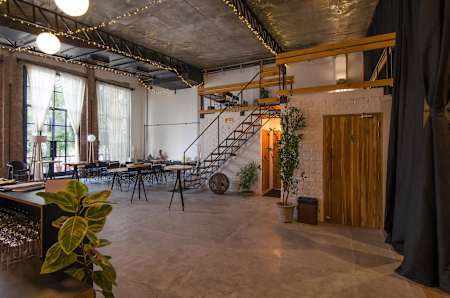
Lobby of the Oddbird Theatre
© Abdullah
The journey to set up Oddbird began in south Delhi in 2015. Wable and Singh were clear that they wanted to create something “closer to where we lived” and among the first challenges they faced was finding the space. For a year, they scouted areas such as Greater Kailash, Vasant Kunj, Vasant Vihar, Green Park and were greeted by bemused property brokers and prospective landlords. “They would just randomly slot it one way or the other. 'Acha club hai. Acha restaurant hai.' And we were saying, 'Nahi theatre hai.' So at one point we just stopped trying to explain ourselves,” Singh said.
Their current landlord wasn’t entirely convinced by the duo’s plans, initially, but now that Oddbird is up and running, he pops in regularly to watch a performance with his family. “Even parents didn’t understand, and our friends kinda got it… we also don’t like to talk about the place that much. We’d much rather have people experience it,” Wable added.
Wable and Singh work with Virkein Dhar, the director of the IGNITE! contemporary dance festival, to curate the programme at Oddbird. She met the duo in 2016 at an event she’d organised for emerging choreographers of contemporary dance at the Gati Dance Forum and joined them to scout for a suitable space. An architect by training, Dhar’s initial conversations with the duo revolved around the physical design of the space and how it should be kept open, flexible and informal. Once the theatre was up and running, Dhar, Wable and Singh began to work on the programme and collaborate with prospective artists who they’d want to perform at Oddbird and vice-versa.
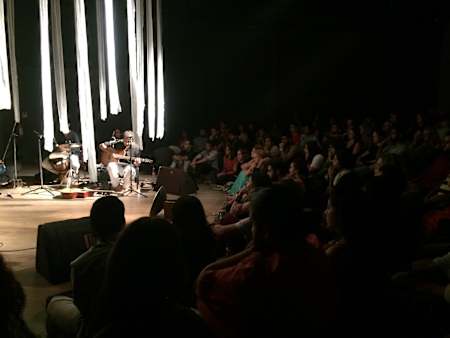
Naad Võim in Concert at Oddbird Theatre
© Virkein Dhar
The trio saw themselves as “facilitators” for performances and would work closely with those to who they give a platform. They’ve created a process that includes responding to first queries, background information on performers, personal meetings with them, figuring out technicals and communications plans.
“We’re a very small team, and we’re dependent on a large part of their own performance, but we facilitate whatever we can,” Dhar said. This again is a markedly different approach from how traditional performing arts venues function in Delhi where artists pay an auditorium, book it and then figure out ancillary aspects like sponsorships and ticketing. The diligence and meticulousness that comes with curating a programme are absent and, Dhar claims, there’s very few venues in India that adopt the approach they do at Oddbird. “We want to make sure that people are serious about performing here, so this is not just a venue for hire,” Wable said. “This is a place where they need to come and think about how their performance is going to unfold. That’s what we look for immediately because we want to be able to stand behind things that happen here,” he added.
Another striking feature of Oddbird is the partnership between Singh and Wable itself. Both of their families knew each other, and they were together in New Delhi’s Vasant Valley school. “She grew up a dork, worked in New York for a while at a TV channel and, when she came to India, told everybody she’s doing muppets. Part of her reason to do Oddbird was to collaborate with other artists to do jingles,” Wable said, jokingly, about his partner. After a three-year-stint with Please See Advertising, a design and ad agency, Singh decided to venture out on her own. Wable, in Singh’s words, “was one of those really intelligent people who got into college before anyone else”.
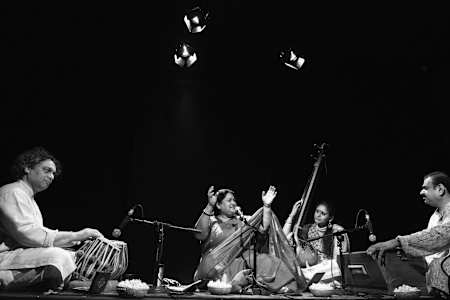
Premghan Concert at Oddbird Theatre
© Raghav Pasricha
After stints at such tech companies like Facebook, Microsoft, Dropbox and Cove, Wable returned to India in 2013 and took a year off. It was during this time that he got back in touch with Singh and both of them became business partners. Their first venture was Relisted.com, a now-defunct curated website.
“He’s one of the brightest people, most perfect people I’ve met. It’s really hard working with him,” Singh said laughingly. Like most professional relationships, theirs is like an arranged marriage where they’re both involved in each other’s lives, share the same vision and try to figure out “what makes the other person tick”, she added. While Singh likes things to be planned, systematic and “is comfortable in knowing what’s happening, Akhil does like to experiment more,” said Virkein Dhar. “Akhil and I like to do a lot more DIY kind of style and test out things before,” she added.
A regular day involves emailing, formulating weekly plans and streamlining operations. But the most enjoyable part of the daily grind involves meeting prospective performers. “If there are no shows, we pack up by 7 and go home,” Singh said. “On show nights, audiences start coming in at 7pm so for the next two-three hours, it’s hosting them while they’re here.”
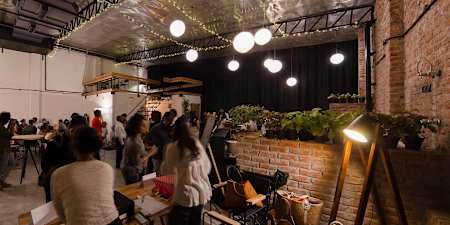
Panorama of the lobby before a show
© Abdullah