
Gaming
Games
How PES is staking a claim in the licensing war
Konami’s Adam Bhatti talks taking on EA and securing partnerships with Liverpool, Dortmund and more.
Over the last couple of years Pro Evolution Soccer has gone from strength to strength. The move onto the new FOX engine, along with the change in console has revitalised the team after a difficult few years in the shadow of FIFA. Now PES is widely regarded as having some of the best gameplay out there, and many consider last year’s outing to be one of the best football games of all time (along with FIFA 16, of course).
But there has always been one area that PES has struggled with ever since its first outings: licensing. FIFA has almost every licensed team you could ever want, along with many of the top competitions from around the globe.
Whether it’s Accrington Stanley, Real Madrid or some obscure team from the Chilean league, you can be sure that the club’s official kit, players and badges will be in FIFA each year, adding to the authenticity.
PES on the other hand doesn’t have quite the licensing power, with the likes of Man Blue, North East London and Yorkshire Orange gracing the English League, leaving devoted modders to work the real names we know and love back into the game for everyone else.
This year, however, PES is fighting back.
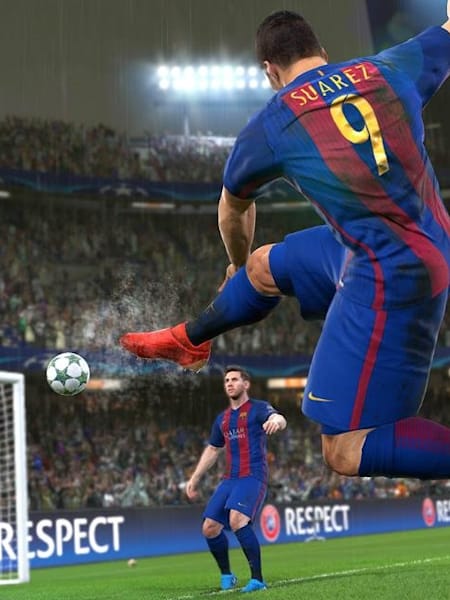
The team have signed licensing deals with Barcelona, Borussia Dortmund and Liverpool to make sure that all the correct kits, badges and even stadiums are in PES 201.
At Gamescom, where the team announced the Dortmund deal, we caught up with Adam Bhatti, the global product brand manager and general PES fanatic, to talk about these new partnerships and how the team hopes to be able to bring in even more licensing deals in the future.
“The challenge for us is actually trying to follow a path that fits in with PES that doesn't fight EA, because what they are doing and what they have is unfortunately a completely different world to what we have,” says Bhatti when talking about trying to secure licenses that FIFA has had tied up for years.
“We are hoping to really finalise a way of fighting licences. What I mean by that is that this is just a new path that we are trying to take. I think it's very difficult in a way to make sure that we are doing things that make a lot of sense. The partnerships seem like a good idea now, a good idea to show the world, to show the fans, but also show the football teams, the clubs, the leagues that this is what we can do for your team, we can put them on the map.”

The Nou Camp in PES 2017
© Konami
While the likes of Liverpool, Barcelona and Dortmund don’t exactly need to be put on the map, as they are three of the biggest names in world football, the work the PES team has put into these deals shows their commitment levels. Each of the stadiums look incredibly realistic and the atmosphere is scarily lifelike, showing what can be done when the team has access to all the official assets.
Of course if more licences were acquired over the coming years, the same level of detail might not be possible for all the teams. It takes a lot of work to make sure everything is perfect. But putting in this work now, while they have the chance, is, according to Bhatti, going to help them secure more licenses in the future.
“Right now, while we wait for some of the license terms to come around and get an opportunity to speak to these licencees, we want to do something and I think these partnerships make a lot of sense,” says Bhatti. “We are lucky because we have got three really big teams, all with a lot of history, wanting to work with us. I think the fact that we have them already means it should be much easier to go and partner with as many teams as possible in the future.”
Ultimately, even putting hundreds of man hours into faithfully recreating every licensed stadium may not be enough to secure some licences, as EA has something of a monopoly on the scene.
Many teams and leagues are currently signed into multi-year exclusive deals, meaning PES won’t even have the chance to speak to them for quite a while. But knowing that gives the PES team some time to plan what they want to do when the chance to speak to the clubs rolls around.
“EA have been in this world for a while,” says Bhatti. “Our USP is gameplay, theirs is authentic-licensed players and leagues; if they don't have that then they are not doing what they want to do with FIFA. So for us it's about actually trying to find a way where we can get these licenses away from them. We don't want exclusives, we just want them to be in our game as well, and we need to find a way where we are not fighting head to head with EA for them.”
There are other factors involved with trying to secure licenses, too. It isn’t just a case of waiting for contracts to expire and then asking to be part of the new deal; there is a lot of money involved, and you know how money talks.

The Liverpool partnership shown in game
© Konami
Konami as a company has had a weird few years in video games, seemingly abandoning console development outside of PES and Metal Gear Solid, and it’s fair to say that they don’t have as much money as EA do to throw around in their games business. This makes securing any top license a significant risk.
“Listen I love PES, I love working on PES, but I can tell you something,” says Bhatti. “Even though we are all really passionate about the game, this is a business. If Konami saw a loss at all on PES I would not be here at Gamescom next year. If you start to splash multi millions on licences, suddenly PES is a risk because you have to sell a lot more copies.”
When it comes down to it, licenses aren't what make or break a football game. If the action on the pitch isn't up to scratch then no one will buy it, but right now PES is at a stage where its gameplay is close to perfect. This gives the team an opportunity to focus on other areas to improve, and bringing in official licenses always helps in that department.

Iniesta fights through traffic
© Konami
“I think we need to give the users much more choice, we need to improve the presentation of PES, we need to really make you feel like you are playing a real match, with all the sounds and visuals,” explains Bhatti. “I really think we can improve that now with these new partnerships, we can really work with the clubs and understand things like the stadium sounds and atmosphere better than before.”
Sales are ultimately the end goal for any game. More sales means more money for the company, which should in turn mean more of a budget for the next year’s game. A handful of licenses probably don't have too much of a direct impact on sales, but once PES starts to get a solid group of official teams involved the optic should become noticeable, providing they keep the same quality gameplay.
“Since 2007 maybe we had six years of really really bad times with PES, and with PES 15 we turned a corner, last year we improved again and I think we need another four or five years,” says Bhatti when talking about improving PES’ sales figures.
“Honestly I think we need another four or five years as the best football game before we can even think about selling more, because we lost all of those sales from the previous years based on a really consistent bad run. We need a really good run now, but I really do think we can do that.”
With PES 17 set to have some of the best football gameplay we have ever seen and some of the biggest licences in the world, the battle for football game supremacy is once again heating up. The next few years should be some of the most interesting yet in the age old war between FIFA and PES, especially now that PES can stand up in the licensing department.
For more gaming coverage, follow @RedBullGames on Twitter and like us on Facebook.
