
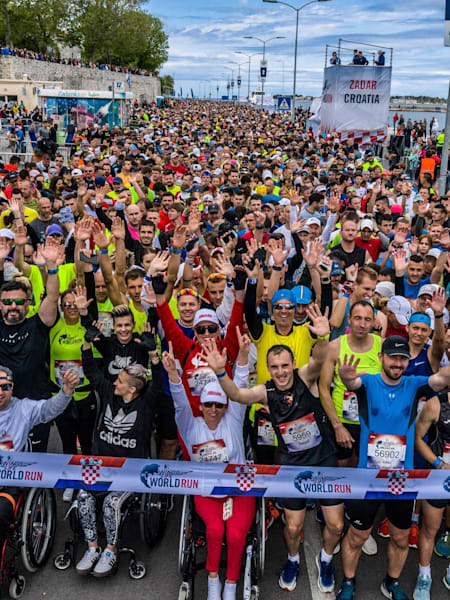
Løping
5 things you need to know when registering for the Wings for Life World Run
Wings for Life World Run is on May 3, 2020 and registration opens on November 13, 2019. For repeat runner refreshers, Catcher Car catch-up sessions for newbies or just a few weird facts, read on.
There's no other running race like it, and you can register here for Wings for Life World Run right now at a race location to suit you.
However, you might want to find out or remind yourself just what makes it unique with our five useful pointers and decide what will be your best fit.
1. The finish line crosses you, not the other way around
Yes, you start running and then 30 minutes later the Catcher Car sets off and begins to creep up behind the field, its set speed getting faster at various checkpoint distances on the way, and as often as not with a celebrity like Aksel Lund Svindal or Matthias Walkner at the steering wheel. When it reaches you, it records the distance you've run and that's your mark.
In 2019, the best running distance was about 54km for women (Russia's Nina Zarina) and 64km for men (Russia's Ivan Motorin). Just so you know what you're aiming for. A highlight of the 2019 was Switzerland's David Mzee walking across the start line in Zug – David has been paralysed for years due to a spinal cord injury; he pushed his wheelchair for 390m before the Catcher Car caught up with him. Watch him in action here:
1 min
David Mzee walks the Wings for Life World Run
David Mzee helped launch the 2019 Wings for Life World Run on Sunday May 5 by getting up from his wheelchair to walk over the start line in the Swiss town of Zug.
To see some Catcher Cars in action have a look at the clip RedBull.com produced a few years ago below.

1 min
Wings for Life World Run countdown #6: Catcher Car
Catch action of the Catcher Car. Will it catch you?
2. You might be running in the middle of the night
Organisers have to choose a time for everyone to start in the whole world. That's a simultaneous starting gun but across dozens of time zones in lots of races all over the world. An 11am UTC start means a relatively leisurely breakfast in Germany, but an early alarm call in California (4am start) and the need to keep yourself energised and motivated all day long in Australia (9pm start – head torches are a handy extra piece of running kit).
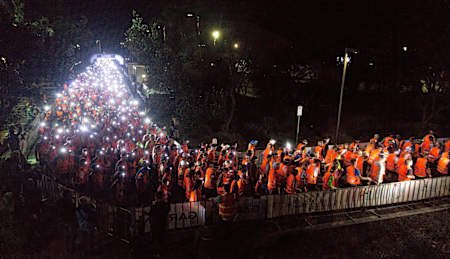
Running by torchlight in Melbourne for the Wings for Life World Run
© Mark Dadswell for Wings for Life World Run
3. You can run the race in your local park
No, not just training runs, the actual thing. It puts that possible early start in perspective if you can just fall out of your own front door, right? The simply titled 'App Run' is a race using a Wings for Life World Run app on your phone with a start time that's the same as Organised App Runs everywhere else and a virtual Catcher Car within the app following you like a phantom as you pound your local streets.
The app and your phone's GPS record your distance so the only thing on the phone you have to worry about is choosing your playlist – tens of thousands of people raised money for the cause by running this way in 2019, some of them in Organised App Runs, surely the running equivalent of a massive silent disco. See a video in the below player from the 2017 edition explaining the app.

2 min
Run with the Wings for Life World Run App
Find out how the Wings For Life World Run app run works.

4. It funds an enormous amount of spinal cord injury research
Like most brilliantly organised running events, people are running for a cause, in this case a cure for devastating spinal injuries. Wings for Life was set up in 2003 and now works in dozens of countries on various projects committed to finding that cure. The charity, and Wings for Life World Run, take not-for-profit to the limit, with every cent, penny or other smallest currency denomination raised in its name going towards research, with no admin fees, tax or other costs deducted. So what you pay to take part in Wings for Life World Run or raise in sponsorship is what reaches those key projects.

Proceeds from the Wings for Life World Run aid spinal-cord-injury research
© Richie Hopson/Red Bull Content Pool

5. The total distances run are quite staggering
Every running and wheelchair participant in more than 200 locations worldwide is covering a massive amount of asphalt, so let's do some maths here.
Running to the Moon? In the first year of Wings for Life World Run alone (2014), the global field ran a combined 531,000km, far enough to reach the Moon and run a third of the way back towards Earth (admittedly you'd probably want to keep going from there). How about staying on the planet? That same distance is 13 times around the equator. Or put it this way – it's estimated that the average person takes 7,500 steps every day. If you live to 80 years old (good luck, if you're doing Wings for Life World Run you've every chance), that's 216,262,500 steps. With an average stride, that’s 177,000km in a lifetime. So, those 2014 runners, in just one day, ran as far as three averagely fit 80-year-olds cover in their lifetimes!

Some older runners at Wings for Life prove that age is no barrier
© Denis Klero for Wings for Life World Run