
Breaking
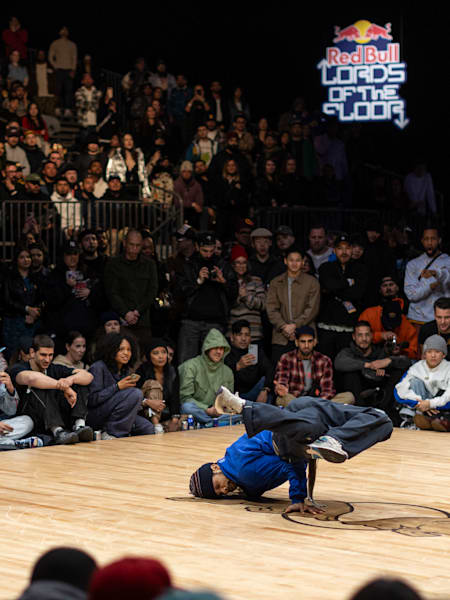
Breaking
Ultimate guide to flexibility techniques for breaking
You should know the stretching basics and how increasing flexibility can help you execute your set.
There’s no question about it — to pull off complex power moves, like the kind you see from breaking star B-Boy Victor Montalvo, you have to be flexible. Flexibility comes from consistent stretching, which reduces stress, relieves muscle pain, and improves strength and coordination. Plus, it helps prevent any potential injuries. So it’s pretty crucial to bend, flex, and move before you throw down — and after. But ahead of twisting yourself into a yoga pretzel, you should know the stretching basics and how increasing flexibility can help you execute your set.
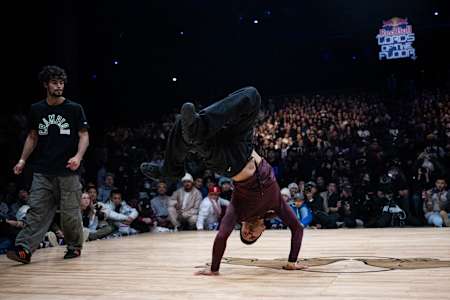
B-Boy Victor at Red Bull Lords of The Floor 2024 at WAMU Theater in Seattle
© Little Shao / Red Bull Content Pool
01
Understanding flexibility in breaking
No matter if you’re a breaking pro or just starting out, you may have already felt where your body is sore the next day. Those are the muscle groups you should target. Your core, arms, chest, and back muscles need stretching for you to perform your best — not just that day but also the next. Your upper body carries the moves, and strength alone isn’t enough.
For example, if you have a lot of strength in your abs but not enough flexibility, expect to be as stiff as a board the day after breaking. And while your upper body is the star of the show, don’t skip leg (stretch) day.
Types of stretches for breakers
There are three types of basic stretches to improve flexibility, each with their own benefits: dynamic, ballistic, and static. Dynamic stretching goes through a full range of motions that are mostly low-impact. You’ll often use your whole body in a dance-like fashion to continuously move your joints. These stretches are great for coordination, increasing the blood flow to your muscles, and boosting physical performance. Performing dynamic stretching is spot on for pre-workout flexibility.
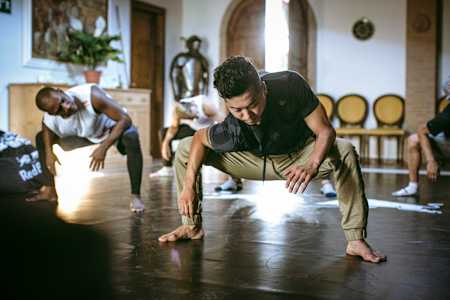
Red Bull BC One All Stars stretch before the Red Bull BC One Training Camp
© Mauro Puccini / Red Bull Content Pool
Ballistic flexibility demands quick movements, executed with momentum. Because of that, you have to be already warmed up or you’ll hurt yourself before you even get started. But once you’re properly loosened up, safely performed ballistic stretching can help your muscles stretch farther. Because of the force you’re putting into ballistic stretches, it can help you take a move to the next level.
Static stretching is especially beneficial after you work out. With this kind of flexibility, you move into a position and hold the stretch. This can extend your muscles. But overextending is a big no-no — static stretching is never intended to be painful.
Advanced flexibility training for breakers
An advanced form of flexibility training is called PNF, or Proprioceptive Neuromuscular Facilitation. It was originally developed as a form of rehabilitation. Though it’s still excellent for that, it also has been proven to increase range of motion and flexibility in those without injury. PNF’s main goal is to both stretch and contract a specific muscle group. Like all other stretching techniques, it’s best to practice consistently — but PNF is at its most effective with a partner. PNF is also one of the techniques that is most effective after exercising.
An example of PNF stretching is an athlete laying on the ground with an extended leg that’s being stretched by a partner against their own tension. PNF is great for extending your range of motion and flexibility, but use caution when practicing. You don’t need to use full force when performing that stretch. This is one of the main things to keep in mind with PNF to prevent injury.
02
Essential flexibility exercises for breakers
B-Boy Lee gives a workshop during Red Bull Bc One Camp 2023 in Paris
© Constance Thiébaut / Red Bull Content Pool
Regular stretching sessions can help improve your overall routine and reduce injuries in everyday life. Strength training exercises have also been shown to help improve flexibility and mobility. The combination of these is the sweet spot for the artistic sport of breaking. Here are some exercises that can help your break move flexibility.
Flexibility exercises for your lower body
A couple of great lower body stretches are all about the squats.
- Single-leg squat: Start by standing on one foot with your weight shifted for balance, with hands by your sides. Move your other foot behind your standing foot and rest only your toes on the ground. Then squat down with your knees forward and touch your hands in front of you — it’s super important to engage your core here. Do a couple of reps then switch sides. Repeat.
- Cross-step squat: Begin by standing wider than hip-width. Use one hand to touch the opposite shin. Raise your other hand up. With the leg you touched, lunge forward to position it in front of the opposite leg. Squat down. Then stand back up to your starting point. Do a couple of reps of this, then switch sides. Repeat.
03
Flexibility exercises for your core
Time to engage your abs.
- Knee tuck: Lie down on your back and lift your legs, hovering at a 45-degree angle. Use your core to lift yourself up into an almost seated position. At the same time, tuck your knees into your chest. Grab your knees with your hands and release your legs. Then move back into your starting position.
- Break ab kicks: Sit on the ground. Raise your knees up so that your feet are hovering above the ground. While balancing on your glutes, lean your body to one side. Place that hand on the ground and gently kick your legs in the opposite direction. Move to the starting position and then do the opposite side.
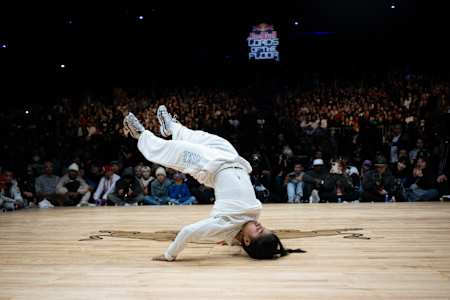
B-Girl India at Red Bull Lords of The Floor at WAMU Theater in Seattle
© Little Shao / Red Bull Content Pool
04
Flexibility exercises for the rest of your upper body
Up your performance.
- Push-up: You may be familiar with this one, but there’s always room to improve and make sure you’ve got proper form. Start by laying face-down, toes tucked, elbows bent. Your hands should be by your ribs. Tighten your abs and push your body up with your arms. Make sure your back is straight. When you lower your body again, don’t touch the ground and keep your elbows at a 90-degree angle. Then push back up again.
- Thoracic rotation: Start in a kneeling position. Put one hand on the ground with your elbow straightened out. Place your other hand on your head with your elbow angled. Now touch elbows: your angled elbow moves with your arm and twists your upper body to the straightened elbow. Then slowly twist up to point the angled elbow to the sky. Hold, switch sides, and repeat.
05
Common flexibility mistakes to avoid
Flexibility training is a great technique to incorporate into your workout. Here are some things to watch out for:
- Not warming up at all. There’s a difference between a warm-up and flexibility training. There’s research to support that a heart rate of 130 BPM for at least 10 minutes is needed to avoid pulling soft tissue.
- Don’t overextend when warming up. If you’re bouncing or swinging limbs in random directions in your warm-up session, you’re risking micro-tears in your muscles. If you’re looking for a way to prepare for flexibility training and exercise, a cardiovascular activity for 15 minutes is way more beneficial.
- Phoning it in. If your goal is to become more flexible, make a point to stretch deliberately. If you’re still able to talk or laugh during your stretching sessions, you’re not going to get actual results. Instead, be sure to concentrate and put the right amount of energy and exertion into your flexibility techniques.
- Thinking pain equals gains. Stretching should give your body a bit of discomfort, but pain is your body’s sign that you’re dangerously close to injury. Get to know your pain threshold by gently pushing yourself each time you practice. Pull back when you’re crossing this threshold.
- Cutting out early. While you still have to keep your body’s comfort in mind, research suggests keeping a stretch for at least 30 seconds for effectiveness. You can build your way up to this. Start slowly to avoid tearing something.
06
Incorporating flexibility training into your routine
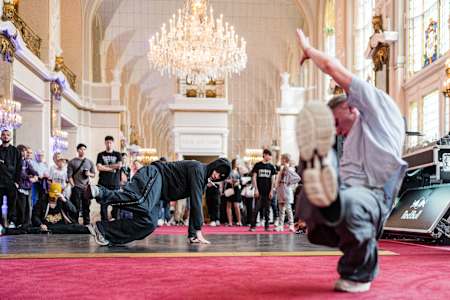
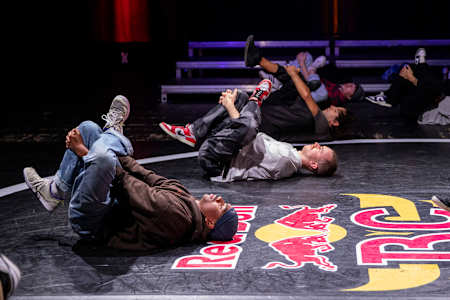
Warming up at Red Bull BC One Cypher in Berlin in 2024
© Nady El-Tounsy / Red Bull Content Pool
Training in flexibility is as important to your craft as practicing your set. The more you do both, the better you can execute. If you already have an exercise routine, make a point to add dynamic stretches before you work out or throw down. Pepper in some ballistic stretches after you’ve warmed up and wrap up with static stretches and PNF after exercising. In between those stretching sessions, be sure to include some strength training and even cardio.
Also, be patient with yourself. Measuring flexibility day by day isn’t the most successful method. Some days our bodies feel more restricted in motion because of any number of factors. Instead, check in on your progress every four to six weeks.
How do you know your new routines are working, though? Ask yourself a few key things. Has your range of motion increased for a specific move? Are you getting to that pose more easily? And how smoothly are you doing it? If after a month and a half, you’re not seeing results, switch to different types of exercises.
Now put it all in motion
Flexibility is good for your body and set, but stretching is also great for your mental health. You’ll feel more confident once you’re hitting your moves more accurately. If you want to get inspired by how the greats use their flexibility while breaking, make sure to check out Red Bull Lords Of The Floor and upcoming Red Bull BC One events. You’ll get to see real live examples of how much it pays to prioritize flexibility in your routine.
