
Dance
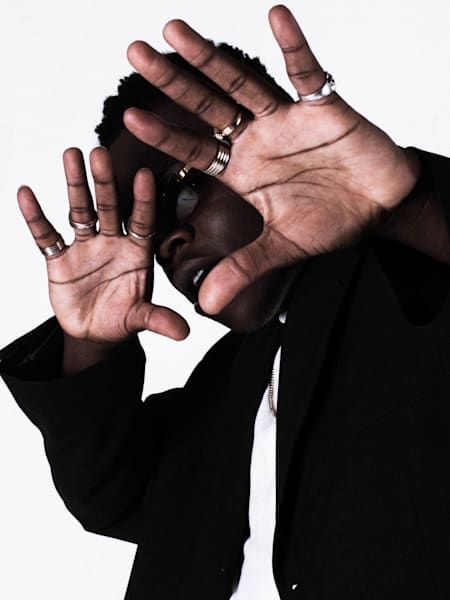
Nigerian dancer Stephen "Papi" Ojo is ready for the Afrobeats Renaissance
As African culture infiltrates pop culture, Papi is excited to be both student and teacher.
Stephen “Papi” Ojo was born in Nigeria, where he started dancing at church. Naming ceremonies and church anniversaries were his time to shine as a member of a praise dance group. While these memories are seared into his brain, they pale in comparison to some of his more recent endeavors, which have included working alongside some of the biggest artists in the world, including Janet Jackson and Beyoncé. He’s ascended to new heights as a master of Afrobeats—he recently dropped an infectious track called “Beremole”—and African dance, both of which are infusing pop culture with their unique creativity and ingenuity.
When Rihanna hit the South African Gwara Gwara on the Grammy stage in 2018, Ojo was right next to her. It was him who helped Janet Jackson pull off the Kupe dance in the “Made For Now” video, a dance that was created by Ghanaian choreographer Incredible Zigi. Most recently, and notably, he appeared in "Black Is King," Beyoncé’s visual tribute to Africa. He played the Blue Man, a divine figure who watches over the film’s protagonist as he goes through life. Ojo really shone during the visuals for the song “Already” where he delivered an explosive solo performance and duet with Beyoncé.
But the use of sounds, moves, and looks inspired by African culture, hasn’t come without criticism from skeptics concerned about cultural appropriation. Ojo shared his unique perspective on this cultural exchange with Red Bull. He also discusses how teaching African dance to A-listers put him in the role of student as well.

Stephen "Papi" Ojo
© Dagbo
Congratulations on all of your success! How are you balancing the highs of this moment in your career with the pressure and uncertainty of this year, and our changing world?
Thank you so much. This year is definitely different. This year has been a blessing in disguise for some people, and a very tragic year for some people. Even though I've lost friends and friends of friends, I'm happy to see some positivity in this year. Honestly, so far it's been great. Ever since "Black Is King" came out, my life has transformed from what it used to be and I'm just grateful to god that I'm able to enjoy it.
What did you learn from working with Beyoncé on "Black Is King"?
Working on "Black is King," even apart from [Beyoncé’s] work ethic, I learned how to carry myself as a human being. [I learned how to] carry myself with class. Especially given the fact that I was working with a whole bunch of people, being able to maneuver and communicate with different people with different skill sets. I was able to learn how to understand people, in general, in a better way. I learned to put myself in a different class because once people see you in a different light, they respect you differently.
That's probably important for folks because a lot of folks cross over between different types of dance from street dance, to classically trained, to being on set. The vibes and the culture of all of those spaces are different.
Right. Exactly!
What was it like working with JaQuel Knight, another amazing choreographer?
Working with JaQuel was so cool. It was an eye opener. Being an aspiring choreographer, I was able to learn, firsthand, from someone who has choreographed A class artists. I was able to see the way he communicates, the way he demonstrates the moves, how to talk to Beyoncé, how to talk to the other dancers. [I got to see] firsthand the blueprint of what's making him successful. A lot of people just see his work on TV or see his work on social media. They don't get to see him in his actual element. I got to see that. I got to see him talk to Beyoncé and say, "Hey, if you do this this way…” I got to see the way he spoke to her manifested in what she was doing. The way he was communicating with her, I got to see the results of that. For me, it was just like wow. There is so much more to what's going on behind the scenes that I didn't know. I just see the choreo being done and think this is lit. But there's so much more that I have to take into consideration to be a great choreographer.
So, you were really learning how to teach?
I was really learning how to teach, how to talk, everything. Everything matters. If you're a choreographer that's really good at choreographing but you don't know how to express it and figure out what to say, you're not going to go anywhere. I was able to see that. Plus, if you're working with an A-list artist like Beyoncé, there is definitely a way you need to speak, a way you need to communicate [so that] she doesn't feel disrespected, like you're trying to downplay her, or talk to her like she's dumb. I had to learn what vocabulary words to use and things like that. I would make them feel like he's just trying to explain this thing to me. He is not trying to look down on me or feel too big over me.
Are there other dancers that you admire or are super impressed with?
Parris Goebel is a choreographer I really love. Tanisha Scott. I have dancer friends here that I'm always around that I look up to like Ghana Boi, Incredible Zigi, SayRah Chips, King Kayak, Blacka, Slip Dance. It's a whole bunch of people that I really look up to. I just watch the way they move and I'm always inspired.
What was it like working with an artist like Teyana Taylor, who is more than an artist and student, but also a choreographer herself?
Seeing Teyana teach and choreograph, I was like: 'Bro, what?! It just goes to show that there are people who are really talented in this world and take their work really seriously. Someone like Teyana Taylor, [with] that platform, doesn't have to do what she's doing. She could just get someone to do it for her. The fact that she wants to have that one to one connection with her dancers is so dope. People [can] definitely read energy and feel energy. If the dancers aren't in sync with the artist, it's going to show in the performance. The fact that we were able to be in Teyana's circle, speak to her, and see her real self just created this bond between the dancers and her. So, when we performed, everything was so in sync. It was amazing.
We know it's super important for you through your work as a dancer to feel like you're representing African culture and Nigerian culture. How would you respond to people that think "Black Is King" didn't properly represent African culture?
Everybody has a right to feel the way they want to feel about different stuff. You can never really please everybody in this world. Beyoncé has a huge platform. It's ok for somebody like Beyoncé to want to express the royalty of Africa. I feel like a lot of people are so used to Africa being demoralized and just looked at as being poor, and this place where nothing good can ever come out of it. It's like we've gone through years of just seeing that. I personally have no problem going the next 20 years with that same narrative of Africa as royalty, because for the past 100 years Africa's been "poor." So, I need the next 100 years to portray Africa as royalty [and] as the place to be. It's like what can one person do? Beyoncé herself can't show the whole [of] Africa in an hour and a half movie. It's not possible. She can only do the best she can to show what she could show, to get the message out as Africa being beautiful, being artistic, and being extra vacant. You just have to appreciate that piece of art. People need to understand the work that went into traveling to different cities [and] different countries just to capture one second or two seconds of that country to make the movie. She invested a lot of time and money for people to be represented properly and as royalty. She could have definitely stayed in the United States and had people build it in a studio and it would have looked exactly the same. But the fact that she had people travel out there to capture the shots, capture it raw, and capture it as it is and bring it back, people just need to appreciate that greatness. She didn't have to do any of that.
How do you feel about the fact that African dance has become so popular, from viral social media content, to performances that you have been part of like Rihanna hitting the Gwara Gwara? Do you feel it's more appropriation than appreciation?
I'm happy that African dance and African culture is spreading fast because it's about time. I feel like there are so many people who are misplaced [and] lost on their African roots. It's time, now that it's exposed, for people to really dig deep and figure out where they're from, what tribe they're from, what country they're from. People really just want to be connected to that. There's always going to be appropriation. No matter how authentic you want to do stuff, no matter how genuine you really want the thing to be, there's always going to be some sort of appropriation. Even Africans doing American dances, there's some kind of appropriation there. It's just how you appropriate it that matters. If you're appropriating it in it's true form and you're not trying to dilute anything then you're fine. But if you're trying to do all this extra stuff then it becomes a problem.
You've already worked with everybody! What are some of your goals and dreams for the future?
I wish I got a chance to work with Michael [Jackson]. What I'm working on now, I'm actually looking to take my acting career a lot more seriously. I've been working on my acting instrument. So hopefully I get a role on Netflix, or on the big screen when the theaters open back up, and the first movie you guys get to see [has] "Papi Ojo" front and center. I'm also working on my music. I plan on dropping my EP early next year so people should watch out for that. Obviously, [I’ll be] putting out more dance content. I actually really want to work with Drake. I gotta work with Drake. I hope this gets to him: Drake, if you get to read this article, let's set it up! Wherever you are, hit our line! I'm here! Acting, music, let's work.