
F1
Racing for Redemption
Failed young hotshot and unlikely team savior—Sergio Pérez’s turbulent journey through Formula 1 reads like the script of a summer blockbuster. But the Mexican racer is primed for a heroic third act.
It’s heading for late afternoon in Baku, and as the sun dips toward the Caspian Sea, Sergio Pérez is threading his Red Bull Racing RB16B through the narrow streets of the city’s old town, slowly making his way back to the pit straight to restart this year’s Formula 1 Azerbaijan Grand Prix from the front of the grid.
Roughly 45 minutes ago the Mexican driver’s teammate, Max Verstappen, crashed out of the lead. Pérez swept past to take the lead, just as the race was halted. Now Pérez hears the voice of his race engineer over the radio, warning him not to weave to get heat into his tires, as it could hasten a potentially race-ending hydraulic pressure problem.
In his rear-view mirrors, Pérez can see the dark shape of Lewis Hamilton’s Mercedes. The seven-time champion, the sport’s most formidable force, will soon line up alongside him on the front row. No pressure then.
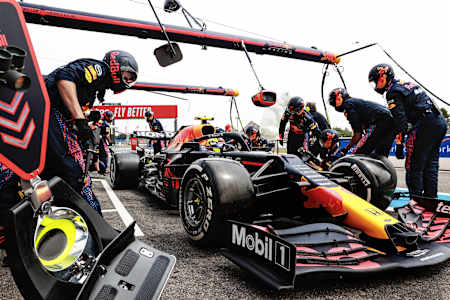
Pérez makes a pit stop during the F1 Grand Prix at Circuit Paul Ricard.
© Getty Images
From his grid slot, Pérez stares down the empty track toward the 90-degree, left-hand first corner. Above him the start lights begin to illuminate.
This is the moment, the culmination of a decade of struggle that reads like the script of a high-gloss Hollywood action movie. The one where the lightning-fast kid gets a shot at the big time and blows it. Or maybe the one where the hero rescues the struggling team only to be axed despite giving them a first victory. Or even the one where the washed-up racer gets a second chance with one of the sport’s biggest teams just as he’s headed for the exit.
In the cinematic saga of Sergio Pérez, it’s all three. And now it’s time to see what’s in the final reel: redemption or ruin, another ending or a new beginning.
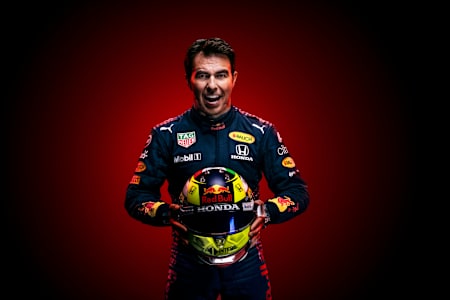
“I’ve been lucky and unlucky,” says Pérez. “It’s been a roller coaster.”
© Markus Berger
Ten years ago, his future looked quite different. In 2011, “Checo” Pérez was a rising star. As a member of Ferrari’s junior academy and backed by the motorsport-mad son of Mexican billionaire Carlos Slim, the young man from Guadalajara was being tipped as a future race winner, and potentially even greater things.
Placed at Ferrari satellite team Sauber, the Mexican driver delivered on the promise. In 2012 he finished on the podium three times, including a second-place finish in Malaysia, where he went wheel-to-wheel with two-time champion Ferrari driver Fernando Alonso. It was only a matter of time before front- running teams would come calling— and when they did, Pérez picked up the phone.
For 2013 he severed ties with Ferrari and signed with McLaren, the team that five years earlier had taken Lewis Hamilton to his first title. Pérez was the British superstar’s direct replacement. What could go wrong?
“It was a year when McLaren was at its worst,” Pérez tells The Red Bulletin now, eight years on from the season that almost sank his career. “It made sense at the time, but unfortunately it didn’t pay off. The car was really bad.”
Paired with 2009 champion Jenson Button—settled and in his fourth year with McLaren—Pérez crumbled. His relationship with the team soured and before the season was over McLaren announced that his shot at the big time was over. For Pérez the only way forward was to go back. Back to the anonymity of the midfield.
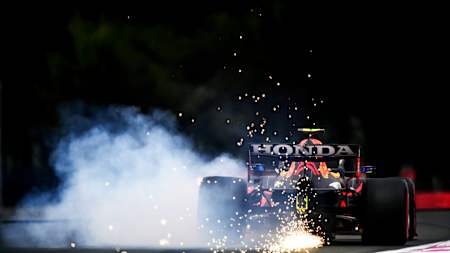
Sparks fly as Pérez drills a practice lap on June 19.
© Getty Images
“You’re in a spot, but you are looking forward to being able to grow and to have a team behind you that you can do great things with,” he says. “So I went back to a small team.” Force India, the plaything of Indian brewing magnate Vijay Mallya, offered Pérez a safe haven, and over the next five seasons he would become one of the sport’s most dependable scorers.
In 2018, though, the refuge was breached. Mallya, the self-proclaimed “King of Good Times,” whose vast Indian Empress superyacht throbbed to the beat of extravagant Monaco Grand Prix parties, was accused of financial irregularities in his homeland. Court cases mounted, assets were frozen. By midseason, Pérez’s team was careering toward collapse.
A major creditor himself, Pérez was petitioned by senior personnel within the team to stave off collapse by taking legal action to force the team into administration. He pulled the trigger.
“It was a tough time for me,” Pérez admits. “I ended up in a position in the team where I could basically save the jobs of 400 people, people who had shared their lives with me. I got involved with lawyers, things I hardly knew anything about. I remember that before going into qualifying, I was meeting lawyers to see what we were going to do. It was crazy.”
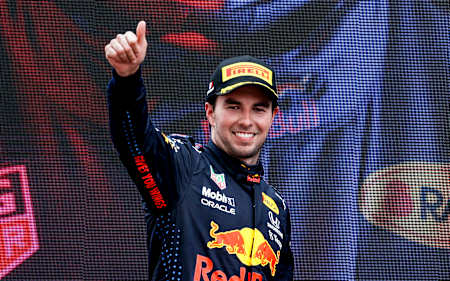
Pérez celebrates his podium appearance at the 2021 F1 Grand Prix of France.
© Getty Images
The Mexican driver’s actions allowed administrators to seek new ownership, and in the fall of 2018 the team, soon to be renamed Racing Point, was rescued by a consortium led by another billionaire businessman, this time fashion mogul Lawrence Stroll, the force behind the Tommy Hilfiger and Michael Kors brands.
And after limping back from the brink in 2019, the sense that a new chapter was beginning for Pérez and the team was confirmed in January of last year, when Stroll took a controlling interest in ailing British sports car company Aston Martin. He injected approximately $240 million into the manufacturer and immediately announced that his F1 team would carry the iconic marque back to Formula 1 in 2021 for the first time in 50 years.
“I felt very secure because it was like my team, my family,” says Pérez, describing the winter of 2019-20. “We were strong together, all of us, from mechanics to engineers. We’d been through such a tough time that with the new owners in place it was looking great.”
But as so often during Pérez’s turbulent journey through Formula 1, just when stability, potential and possibility were within reach, events conspired to once again turn his career on its head. In the end, his second act would end much like his first.
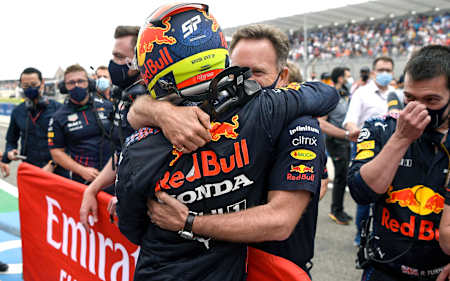
Pérez celebrates with Red Bull Racing team principal Christian Horner.
© Getty Images
Flash forward to July 30, 2020. It was four months after organizers had been forced to cancel the season-opening Australian Grand Prix only hours before the start of practice sessions. A single team member had tested positive for the still largely unknown coronavirus. Formula 1 set up camp at Silverstone circuit in the U.K. for round four of its rearranged championship; everyone involved was in a bubble.
In the wake of round three in Hungary, Pérez received news that his mother, Marilú, had been involved in an accident. He jumped on a private jet and flew to Guadalajara to be at her side before returning for the race in England. Adhering to the sport’s rules, he took a pre-event PCR test. It came back positive.
“It couldn’t have happened at a worse time,” Pérez says. “I needed to be on the track. Driving the car, driving for my team and proving to people that I was the right driver for the team, but I was in a hotel for two weekends. It was a nightmare.”
Pérez’s desire to prove his worth to his team at the end of July was in stark contrast to the buoyant optimism he’d felt earlier in the year, but his concerns were well-founded. Two months earlier, contract negotiations between Ferrari and its star driver, Sebastian Vettel, had irrevocably broken down. And in May, the team and driver announced that at the end of the year they would go their separate ways.
The next destination of a driver with 53 wins and four titles to his name became the subject of feverish speculation, and as spring turned to summer, Vettel was increasingly being linked with a 2021 seat at newly christened Aston Martin. And with Stroll’s son Lance in the sister car to Pérez, it was the Mexican who faced the firing squad.
I want to go all the way and win the world championship.
Pérez spent 10 days in his hotel room in England while gossip linking Vettel to his seat raged in media coverage. The German driver was photographed leaving Silverstone in Racing Point’s team principal Otmar Szafnauer’s Ferrari. He appeared on TV elbow-bumping Stroll in the pit lane. And through it all Pérez was isolated—adrift and powerless.
A month later at the Tuscan Grand Prix, his fate was at last revealed, in the most incongruous manner possible. “I overheard a conversation in the team’s hospitality unit. It’s got very thin walls,” he says with a wry smile. “To be honest I was only upset for about 20 minutes, less than that. I thought: ‘OK, it’s out of the way. I know where I stand and let’s look forward to what’s next.’
“It’s easy to feel betrayed but I understood the business point of view,” Pérez adds. “I definitely felt like, wow, I’ve done so much for this team, but at the end of the day I also knew Vettel was a better opportunity because Lawrence wants to build Aston Martin as a brand. You can’t get too emotional and you just have to look forward.”
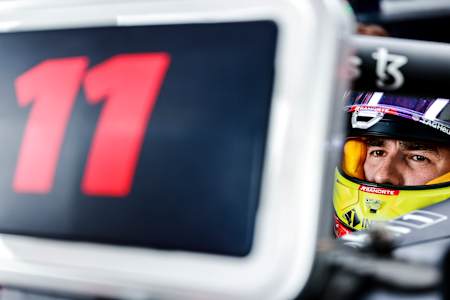
Pérez has his game face.
© Getty Images / Red Bull Content Pool
That became easier said than done as September gave way to October and the final months of the season, as the next step failed to materialize. With just 20 seats available across Formula 1’s 10 teams—and with the majority of drivers settled into long-term contracts—Pérez’s options narrowed to the point that as the campaign funneled toward its final rounds, the very real possibility of an exit loomed.
But Pérez insists that as options evaporated, he was reconciled with that possibility. “I was at peace because I felt that I’ve had a great career—10 years in Formula 1, some podiums, great races,” he says. “I was OK with the fact that if the worst happened, I could go home. I have a beautiful family. I have a lot of opportunities. I always said that when Formula 1 finishes, there’s another great life waiting. I could go to work, learn, become a businessman. My worst scenario began to look very attractive.”
One light at the end of the tunnel remained, however. Red Bull Racing’s young talent, Thai driver Alex Albon, was struggling to find the form that had led to him being drafted into the four-time champion outfit in the final stages of the 2019 season. Pressure from all sides was mounting. But the team was determined to give the 23-year-old enough time to turn things around. This meant that Pérez went into the season’s penultimate race, the Sakhir Grand Prix in Bahrain, knowing that time was running out for both of them.
Now I want to be the best version of myself. I want to give everything to make this work."
And there, for the first time in more than two years, fortune smiled on him. Despite being dumped to the rear of the field in a first-lap collision, the Mexican muscled his way through the field, and when front-running Mercedes imploded in the final stages of the race, Pérez surged through to take the first win of his career. It was the first victory for the team that was about to dispense with his services.
“It was incredible but again there was also peace, because even though I didn’t know what was going to happen in my career, I’d done it,” Pérez says. “I’d worked all my life for that moment and I had done it. I could leave the sport even more comfortable.”
The last two weeks of the season were valedictory. The final round in Abu Dhabi, ostensibly his last in Formula 1, was a blur of team photographs and media farewells—and in the end, a cruel damp squib of a race ended by an engine failure after just eight laps. With his wife, Carola, by his side, he left the Gulf state to go home and begin a new life.
A week later he got that new life—but not the one he’d expected. After failing to recapture form, Albon was moved to a reserve driver role at Red Bull Racing. If he wanted it, the seat belonged to Pérez. Almost eight years after blowing his first chance at a title-contending team, and with one foot out the door of the sport, he was being given another chance.
“I was with my wife when we found out and we were like, wow, we finally got what we deserved,” he says. “I’d spent so many years having this difficult career and all of sudden, right at the end, the opportunity I had worked toward for so long finally arrived. I was ready to grab it with both hands.
“We just had a drink, the two of us, because we couldn’t tell anyone,” he recalls. “My family thought I was going to retire. No one knew apart from my wife. But yeah, it felt great, like being reborn.”
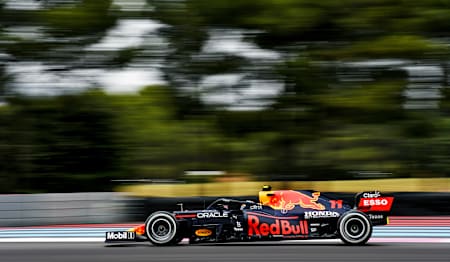
“Those moments are the ones you live your whole life for.”
© Getty Images/Red Bull Content Pool
Back in Baku, it is June 6, 2021. The lights go out. Pérez releases the clutch, and with no heat in his tires, his wheels spin. To his left Hamilton explodes off the line, and though he tries to cover the line as they rocket toward the first corner, he’s out dragged by the Mercedes. This is a harsh reality of racing. Hollywood endings or mythological heroics are rare. Usually precision and mechanical perfection drive the plot.
But then, as they enter the corner, Hamilton’s finger slips. At the back of his steering wheel is a button his team calls “brake magic,” a switch designed to heat tires by throwing the brake balance of the car all the way to the front of the car. His front wheels lock and he careers through the braking zone, inches from tearing off the front end of the Red Bull car. Pérez powers through to victory, to redemption and ultimately to vindication. Roll credits. The unthinkable has happened.
“In all regards my career hasn’t been straightforward,” Pérez concludes. “I’ve been lucky and unlucky. It’s been a roller coaster. But those moments are the ones you live your whole life for. They are moments that will stay with me forever.
“Now I just want to be the best version of myself. I want to give everything to make this work. My kids are growing up and I want them to see me do it. I want to go all the way and win the world championship, and I want to win it with them. Yeah, this is only the beginning.”


