
Gaming
esports
What Makes Overwatch's McCree So Hard to Balance?
Despite his straightforward mechanics, balancing Jesse McCree has been anything but easy.
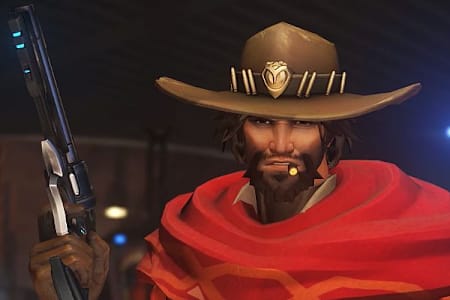
Meet McCree, the face of Overwatch's offense meta
© Blizzard Entertainment
One of the most contested, rebalanced and considered characters in Overwatch’s short history has been the cowboy, Jesse McCree. The one-time criminal is one of the most deadly Offense characters, and a deceptively straightforward one. As that deception has started to yield to better understanding and higher-level play, however, the developers have been tweaking his strengths and weaknesses lately to try to get him to a balanced level.
What makes McCree such a contested pick, and why has he been so targeted in patch notes and competitive play? Furthermore, is McCree’s identity coming across in gameplay? Some heroes have a very clear elevator pitch: Tactical vertical movements with big hits are Pharah’s specialty, while Tracer is a mobility focused speedster. McCree has emerged as an accurate gunslinger with the ability to get out of scraps, thanks to the recent patch changes. The new problem is that he’s crowding the other heroes out. It seems the cowboy will be wandering a little longer as Blizzard figures out how they can get McCree’s power level down while still fulfilling his role.
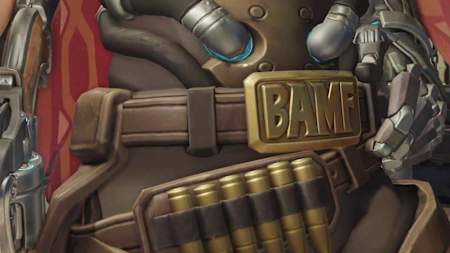
McCree knows exactly what he is
© Blizzard Entertainment
The gunslinger's specs
On the surface, McCree is incredibly simple. Unlike Tracer or Pharah, he doesn’t have any high-mobility abilities that allow him to navigate a battlefield at new angles — he has a simple roll. His only form of crowd-control and utility is contained in a close range flashbang. All of his power and skill is loaded into his six shot Peacekeeper, and especially his alt-fire mode, Fan the Hammer, which empties all six shots at a cost to both accuracy and damage. Here are the finer details of McCree’s kitfor the uninitiated.
McCree’s power is focused in his weapon, and he doesn't have anything fancy in terms of utilities. He lacks the mobility of a Tracer, a Pharah or a Genji. So why has he been so contested and so difficult to balance? Despite the fact that you can pick up McCree’s combos and play style in an hour of Quick Play, his power is all beneath the surface, hidden in range modifier damage and other small, under-the-hood changes. One of the biggest changes has been to both play with his range, and add a strong incentive to hitting people from afar, with McCree’s primary fire doing substantially less damage at close range. These patches have hit McCree’s overall power, making him less of a jack of all trades — but he remains the ace of a few, holding onto a few key mechanics that shift the meta around him.
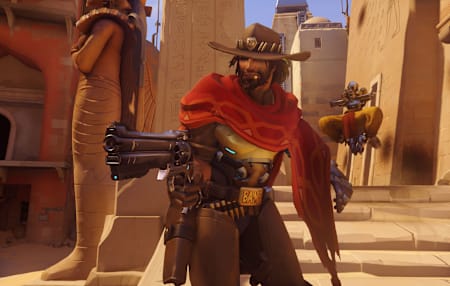
Early gameplay meant McCree had to get up close
© Blizzard Entertainment
Evolution of a cowboy
For practical purposes, we’re going to ignore the tweaks from the November 2015 beta and look at the changes made during Summer 2016. A couple of small tweaks were made during April as well, to the alternate fire recovery time, the standard fire recovery time, and the flashbang stun duration. These tweaks — the .02 seconds added onto flashbang in particular — weren’t substantial, but helped set up McCree’s golden age of dominance. McCree became a core pick, edging out all other Offense heroes. His combo, which was easy to pick up and execute — especially with the free reload that comes with his Combat Roll — allowed him to eat through other offenses, defenses, turrets and tanks. McCree was a monster, and the June 14 changes addressed this with a vengeance, cutting almost half the bullet damage on Fan the Hammer.
A change was needed, and fast; McCree’s base damage on Fan the Hammer had pushed it into, as Kaplan phrased it, an “I win” button against all classes. He wasn’t just gunning down Tracer, but tankier Offense characters like Reaper, and even tanks. When McCree fanned the hammer, you had two options — get out of the way or die.
Jeff Kaplan was incredibly straightforward about his goal for the Fan the Hammer nerfs: "The goal there is to make it so that McCree can still use his combo that we love, which is the flashbang and Fan the Hammer on somebody like Tracer. McCree should absolutely kill that Tracer," he explained. With a fully empowered Fan the Hammer, McCree was unstoppable. After the nerf, his combo was reliable to hit, but it was toothless by comparison. McCree could still eliminate a Tracer or a Genji, but anyone above that health range would survive the combo and, with his Flashbang spent, be able to retaliate easily. An anti-carry carry is not a bad role, but other heroes could do it much better, and McCree fell completely out of style.
On July 19, the Peacekeeper got a tune-up. McCree had lost the damage on his Fan the Hammer, leaving him a bit weak, and so Blizzard looked to the other aspect of his damage — his primary fire. This series of buffs are what gave McCree his current identity of relying on range and picking targets off in duels, using his Flashbang/Fan the Hammer combo when you get up and close and personal to him. The pistol maintained full damage at longer ranges, but dealt less damage at extreme ranges.
While it was a strong stab at fixing the gunslinger's outstanding problems, McCree (and his balance) still had a long road ahead.
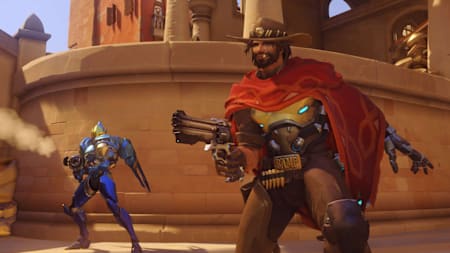
McCree is standing ahead of his Offense peers
© Blizzard Entertainment
Fine-tuning his kit
After the changes, McCree shot back up to being an intensely strong hero, rated as an indispensable "S tier" hero from Planet Overwatch’s seven-day meta report. McCree was patrolling the battlegrounds for over 95 percent of all match time, leaving the other offensive characters in the dust. It’s not a surprise that the next patch rolled out seven days later.
On July 26, they shortened the Peacemaker’s primary fire falloff range by 10 meters and increased his alternate fire’s rate of fire. In short, less damage on his primary fire, but Fan the Hammer fired more quickly to compensate. This kept the new identity that they had forged for McCree, but shaved off some of the raw power that he was packing in his reworked kit.
These changes put McCree down to 74 percent — while he’s still a strong pick, arguably the best offense at the moment, the canyon between him and the competition is smaller. This honed in on McCree’s identity a little more — he’s a bit of a sniper who draws on a single enemy from a distance, while relying on his wits and scrappiness if someone gets up close to him. The new problem? McCree is crowding out the actual snipers. Hanzo and Widowmaker are seeing less play than before, with McCree handling their duties. Tracer, Genji, and Reaper remain used — as previously mentioned, all three characters have unique niches that McCree can’t hone in on. But what of poor Soldier: 76, or Pharah? The new range-heavy McCree is eating their lunch. Keep in mind that while McCree has seen damage changes, he’s still able to exploit headshot double-damage to make up for the damage reduction of an extreme range shot. In casual play with friends, this isn't as much of a problem, but pros can still make those long-range shots.
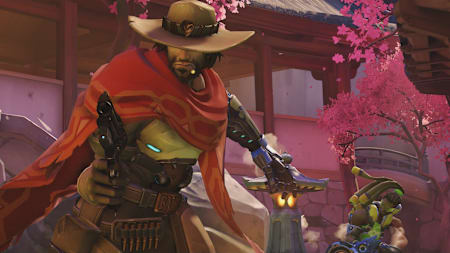
It'll be hard to keep McCree away from the meta
© Blizzard Entertainment
Who is Jesse McCree?
Geoff Goodman commented on McCree’s strength and what makes him a valuable addition to a team. McCree’s flashbang "plays an important role in being a strong option against very agile teams full of Tracers and Genjis. It is also a nice tool to prevent close range devastating abilities and ultimates such as Reaper's Death Blossom." McCree should be an anti-carry who requires precision in both aim and timing, constantly walking the line between a play of the game-worthy combo or getting bursted down. The Blizzard team have already succeeded at a massive part of McCree — his ultimate, Deadeye. From the high-noon callout to the shots, Deadeye has been both thematically appropriate and balanced enough to avoid any changes since Overwatch’s release.
The changes, interestingly enough, play into McCree’s fantasy of being, well, a cowboy. He’s strong when aiming and dueling one opponent, and he can get out of a tight spot with a desperate burst of his six-shooter. So why isn’t this fantasy being conveyed well in game? McCree’s tools are simple, and there aren’t a lot of factors to fiddle with. Many of the changes have been "under the hood," where as D.VA’s Defense Matrix change was a very visible rework.
Does this mean that McCree is dooming Overwatch? Of course not. In fact, there’s a lot to like here: McCree’s trajectory as an Overwatch hero shows that Blizzard is committed to their policy of keeping characters strong, instead of nerfing the ones that stand out. It would have been considered fair, or even justified, to keep McCree as a niche anti-Genji/Tracer hero after the first round of buffs. Instead, Blizzard moved in nearly immediately afterward to buff him up and further solidify his identity.
The problem isn’t that McCree is overpowered; it’s simply that his current identity of long-range gunslinger with close-range fallback abilities is broad. Why pick Widowmaker when you can pick McCree? Heck, why pick Soldier: 76 when you can pick McCree? The cowboy has become a catchall for damage and picking off priority targets. Blizzard has proven they're willing to make some significant changes to keep Overwatch intact, and it will be interesting to see the ways in which McCree could change in the future. After all, it’s become clear that he's more complicated to balance than it appears on the surface. McCree’s next iteration, if it comes, will try to be reasonable.
But he still might not take to it.
For more Overwatch features, follow @redbullesports on Twitter and Like us on Facebook.
